On a short linear move, the axis may decelerate before it reaches the programmed speed. If that happens, raising the speed limit alone saves no time. First compare the available travel with the distance needed to accelerate to the speed limit and stop again.
Decide whether the move has a cruise segment
Assume the carriage starts and ends at rest and uses equal, constant acceleration and deceleration of magnitude a. Let D be travel distance and V the speed limit. Use metres, seconds and m/s² throughout.
- The distance to accelerate to V is V²/(2a). Stopping takes the same distance, so a plateau at full speed is possible only when D > V²/a.
- For D ≤ V²/a, use a triangular velocity profile. Peak speed is √(aD) and travel time is 2√(D/a). At equality, the axis just touches the speed limit.
- For D > V²/a, use a trapezoidal profile. The cruise segment covers D − V²/a. Total travel time is 2V/a + (D − V²/a)/V.
The distance is the area under the velocity trace. With unequal ramp magnitudes a₁ and a₂, the ramp distance at the speed limit becomes V²/(2a₁) + V²/(2a₂). Use the controller's planned trajectory when the move uses jerk limits, blending or nonzero endpoint speeds. Rockwell Automation's positioning manual shows the cruise segment disappearing as travel gets shorter.
Compare two moves on the same axis
Say the speed limit is 1.0 m/s and acceleration is 4.0 m/s². Reaching 1.0 m/s and braking again takes 250 mm. A 120 mm move uses the triangular calculation, while a 600 mm move has room to cruise.
| Travel | Actual peak speed | Ramp time, both ends | Cruise time | Total motion time |
|---|---|---|---|---|
| 120 mm | 0.693 m/s | 0.346 s | 0 s | 0.346 s |
| 600 mm | 1.000 m/s | 0.500 s | 0.350 s | 0.850 s |
If the 120 mm move must finish in 0.30 s, the triangular equations call for about 5.33 m/s² and a peak speed of 0.80 m/s. That request goes back to the motor and module sizing. Check whether they can deliver that acceleration with the installed payload and repeat it at the required duty cycle. Use the speed-torque curve sizing guide when the drive is a stepper.
Build the cycle around the point where work starts
Suppose a station makes the 120 mm move, waits 70 ms for the tool point to stabilize, performs a 90 ms operation and returns at the same motion settings. That adds up to 0.853 s before any dwell or interlock at the home station. If a second axis moves during that interval, check which motions overlap and which must finish before the process can start. Count settling at the point where it affects the process. Use the work-point settling measurement instead of relying on a drive's move-complete bit.
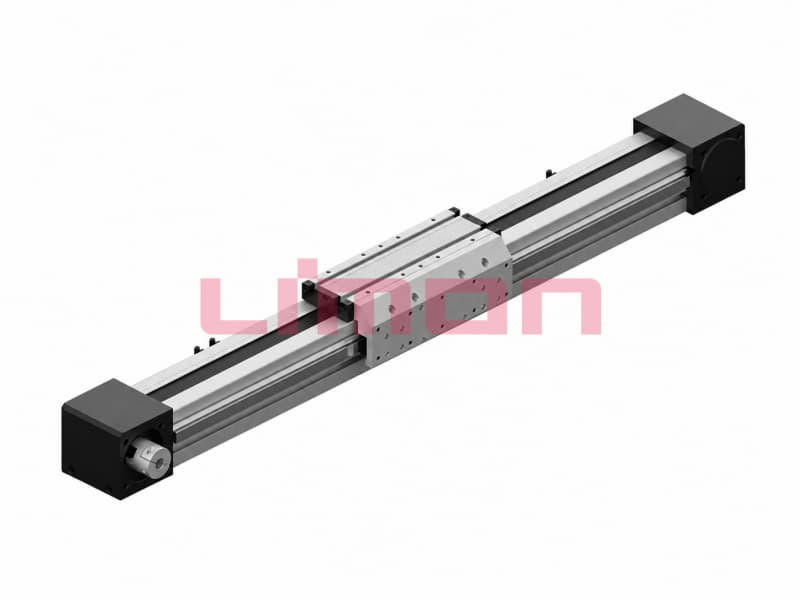
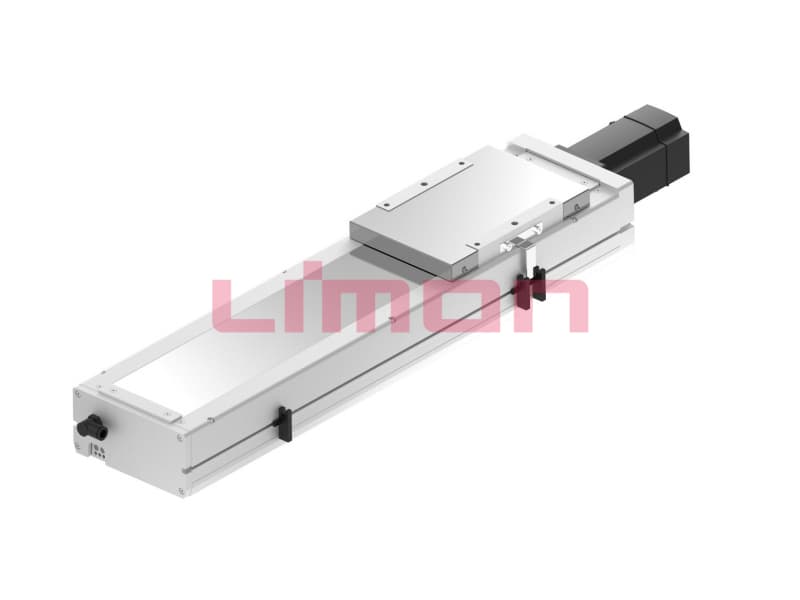
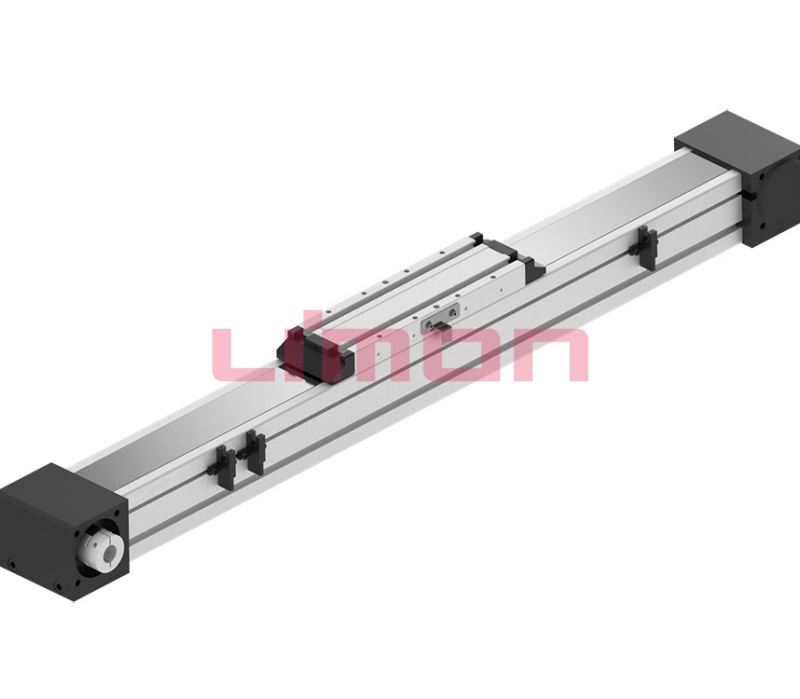
When selecting a LIMON GSC 50 linear module, send each move distance, the payload, start and finish conditions and the full allowable cycle time with your application enquiry. Include settling and process time so the motion budget can be checked against the required throughput.