Unstable motion creates positioning errors, downtime, and rejected products. If ignored, it weakens the whole automation line. A properly selected linear guide restores stability.
A linear guide for automation equipment is a precision motion component used to support smooth, accurate, and rigid linear movement. It is suitable for automatic equipment, semiconductor equipment, laser engraving machines, packing machines, medical equipment, and high-speed transfer systems requiring compact structure, stable positioning, and reliable operation.
Reliable automation starts with reliable linear motion.
➤ Why Linear Guides Are Important in Automation Equipment
In automation equipment, every movement must be accurate, repeatable, and stable. Whether the machine is used for part transfer, product assembly, inspection, packaging, laser processing, or medical equipment, the moving structure must follow a controlled linear path. A linear guide supports this movement by carrying the load, reducing friction, maintaining direction, and improving positioning stability.
If the guide system is not reliable, the machine may suffer from vibration, poor positioning, abnormal noise, unstable running, and faster wear. These problems can affect the final product quality and increase maintenance costs. For equipment manufacturers, distributors, and end users, the linear guide is not just a standard mechanical part. It is a key component that influences machine accuracy, production efficiency, and long-term reliability.
➤ Main Requirements for Automation Applications
Automation equipment usually works under continuous operating conditions. Many machines require high-speed movement, limited installation space, and stable performance over long production cycles. Therefore, a suitable linear guide should provide:
- High rigidity
- Smooth motion
- Stable accuracy
- Compact structure
- Reliable load capacity
- Easy installation
- Convenient replacement
- Consistent quality
For automation equipment, the guideway must not only move smoothly but also remain stable under repeated acceleration and deceleration. Even small movement errors may affect assembly position, cutting quality, inspection results, or transfer accuracy.
➤ E Series Linear Guide for Compact Automation Equipment
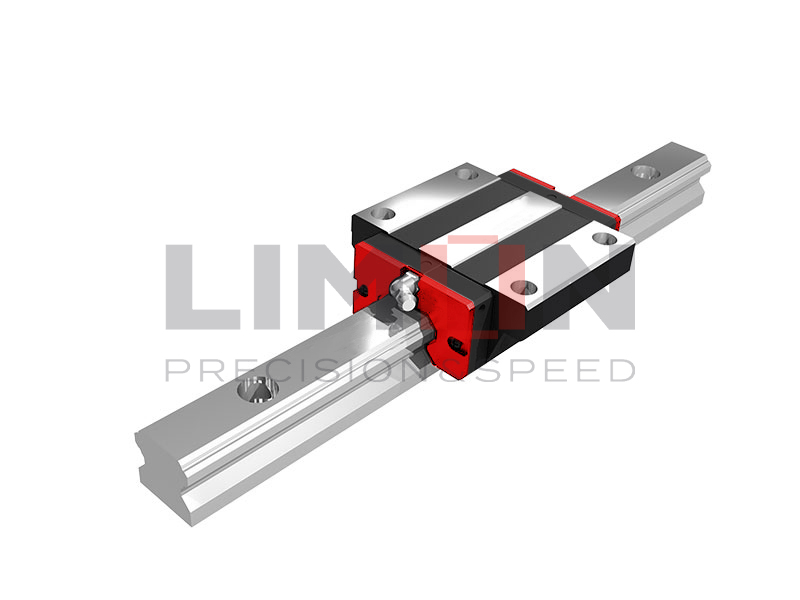
LIMON’s E Series linear guideway is designed for applications such as automatic equipment, semiconductor equipment, laser engraving machines, high-speed transfer machines, packing machines, and medical equipment.
This series offers a low-profile design, high load capacity, and high rigidity. It also has an equal load rating in four directions, helping the guideway support different installation directions in automation structures. Its self-aligning capability can absorb installation errors, making it easier to achieve stable running performance.
Because the E Series has a lower assembly height and shorter block length, it is suitable for high-speed automation machines and equipment with limited installation space. This makes it a practical option for compact machine design, especially when the application requires both space saving and motion stability.
➤ Smooth Motion and Easy Installation
In real machine assembly, mounting surfaces are not always perfect. Small surface irregularities or installation deviations may affect motion quality. A guideway with good self-aligning capability can reduce these problems and help the equipment run more smoothly.
LIMON’s H Series linear guideway uses a circular-arc groove design with contact points at 45 degrees. This structure can absorb many installation errors caused by surface irregularities. It helps provide smooth linear motion, high accuracy, and easy installation.
For automation equipment builders, easier installation means less assembly difficulty and shorter adjustment time. For end users, it can also support better stability during maintenance and replacement.
➤ High Rigidity and Load Capacity
Automation machines often perform fast and repeated movements. During operation, the linear guide may face load from different directions, including radial, reverse radial, and lateral directions. If the guideway lacks rigidity, the moving platform may vibrate, tilt, or lose positioning accuracy.
A strong linear guide helps keep the moving part stable. LIMON’s H Series linear guideway uses a four-row structure and provides equal load ratings in four directions. The circular-arc groove also creates a wider contact area between the balls and raceway, helping the guideway support larger loads and higher rigidity.
This is important for automation equipment because many machines require stable movement in different installation positions, including horizontal, vertical, and side-mounted structures.
➤ Low Noise and High-Speed Performance
Modern automation equipment often requires low noise, low dust generation, and high-speed running performance. This is especially important in semiconductor equipment, precision measuring equipment, medical equipment, and clean production environments.
LIMON’s QH and QE Series linear guideways are designed for high-tech applications requiring high speed, low noise, and smooth movement. With SynchMotion technology, the rolling elements are separated by partitions, reducing contact between the balls. This helps lower collision noise and improve circulation stability.
The self-lubricant design also helps reduce the frequency of lubricant refilling. For automated production lines, this can reduce maintenance interruption and support more stable long-term operation.
➤ Interchangeability and Maintenance Efficiency
For distributors, machine builders, and maintenance teams, interchangeability is an important factor. When blocks or rails need replacement, consistent dimensional control can save time and reduce adjustment work.
LIMON’s H Series linear guideway provides precision dimensional control, allowing blocks and rails within the same series to be used together while maintaining dimensional tolerance. A retainer is also added to prevent balls from falling out when the block is removed from the rail.
This design helps improve replacement convenience, inventory management, and maintenance efficiency. For customers who operate multiple machines, good interchangeability can reduce downtime and simplify spare parts preparation.
➤ Flexible Options for Different Automation Designs
Different automation machines require different guideway specifications. Some need compact size, some need long stroke, some need low noise, and some need stronger rigidity. LIMON linear guideways provide multiple options, including precision grades C, H, and P, sizes from 15 to 45, and accessories such as KK, DD, and ZZ.
For longer equipment structures, 6-meter guideways are also available for certain series. This gives machine designers more flexibility when developing transfer systems, packaging equipment, laser machines, and multi-axis automation platforms.
➤ How to Select a Linear Guide for Automation Equipment
When selecting a linear guide, buyers should evaluate the actual application instead of choosing only by price or size. Important factors include:
- Load direction
- Stroke length
- Moving speed
- Accuracy requirement
- Installation space
- Working environment
- Lubrication condition
- Maintenance frequency
- Expected service life
For compact and high-speed automation equipment, the E Series can be considered. For applications requiring strong rigidity and easier installation, the H Series is suitable. For low-noise, high-speed, and high-tech automation applications, the QH or QE Series can provide additional advantages. For miniature devices, semiconductor equipment, 3D printers, medical equipment, and precision measuring instruments, the M Series is also available.
➤ LIMON Linear Guide Supply Capability
LIMON focuses on linear guides, ball screws, and linear actuators, which are widely used in LCD panel, electronics, photovoltaic, and other industrial fields. With 18 production lines for linear guides and various accessory supply, LIMON supports customers with product selection, stable capacity, and application-based solutions.
Since starting the business in 2003, LIMON has continued developing linear motion products for distributors and end users. Its products have been supplied to Europe, Asia, South America, and other markets, supporting automation equipment manufacturers with reliable linear motion components.
A reliable linear guide improves automation equipment through smooth motion, high rigidity, easy installation, and stable long-term performance.