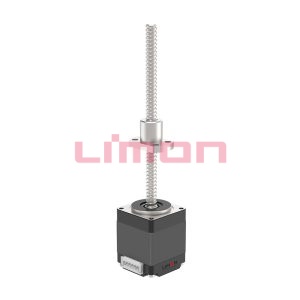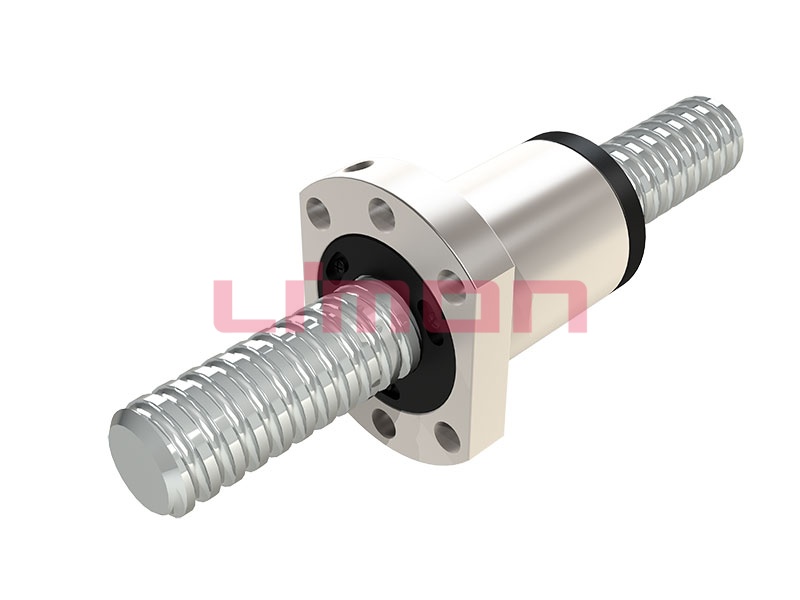
Looking for Bosch Rexroth linear module alternatives? Start with six manufacturers of complete driven axes: LIMON, HIWIN, THK, Festo, IAI and Rollon. Your Bosch axis may work perfectly well; the question is which requirement the selected model or supply arrangement no longer meets. Is it travel, available space, load, controls, a second source or the scope of the assembled system? A screw-driven MKK calls for a different comparison from a belt-driven MKR. For an installed machine, none of these six families is a confirmed bolt-in replacement without a part-number and drawing check. Below, we identify the Bosch duty each candidate could address, how it would do so and what could force a redesign.
First, are you replacing a guide rail, a single-axis module or a multi-axis system?
- A linear guide railconstrains motion; it does not drive the carriage.
- A single-axis modulecombines guidance with a drive—typically a ball screw, belt, rack and pinion or linear motor—in a frame with a moving carriage.
- A multi-axis systemcombines two or more axes into a machine-specific motion arrangement.
These are different purchasing scopes. If you need a complete Bosch module, a rail-to-rail interchange chart will not answer the question.
Bosch Rexroth’s linear-axis overview makes the baseline clear: MKK and CKK are screw-driven, while MKR and CKR are belt-driven. The same overview lists other architectures, including linear-motor modules. Record the full Bosch part number, generation and options before looking for a substitute. Even within one drive family, overall length, usable travel, carriage height, mounting holes, motor position and cable routing can differ.
What is the existing Bosch module not meeting?
For Bosch Rexroth linear module alternatives, begin with the installed axis and this project. An OEM may need a second source or a different quoted delivery scope while the current module still meets its motion specification. A new machine may need a shorter envelope, more travel, a different drive architecture or a motor and controller package that changes integration work. None of those reasons, by itself, proves another brand is cheaper, better built or easier to install.
For a working replacement, ask whether the existing Bosch part number meets the new stroke, payload and cycle requirement. If it does, the comparison may be commercial or about supply resilience; obtain current, like-for-like quotations. If it does not, changing only the brand may be insufficient—you may need a different size or drive concept. And if the failed item is only a Bosch guide rail or carriage, use a guideway comparison: the six entries below are complete driven axes, not rail-only replacements.
Can one of these axes bolt into the same mounting holes?
Unknown until two configured drawings are compared. Matching a drive type, rail width or advertised stroke does not establish bolt-in fit. Overlay the Bosch and candidate CAD at the selected stroke: base-hole pattern, carriage height and holes, overall and moving envelopes, motor position, cable exits, end switches and service access. Then compare payload and moments at the real center of gravity, plus speed, acceleration, repeatability test conditions, brake and control interfaces. A changed motor or controller can also mean new wiring, PLC logic, homing and safety validation. Treat any remaining change as an engineered retrofit, with time and responsibility agreed before ordering.
Bosch Rexroth linear module alternatives: six complete-axis manufacturers
| Manufacturer | A sensible first look for | Origin (company HQ) | Typical buyer comparison scenario | Boundary to check |
| LIMON linear axes | Named GSC40 compact screw or YRO170 long-travel rack candidate. | China | An OEM wants a project-configured mechanical axis with defined drawings and quotation scope. | Compare the exact geometry, duty, motor/control choices and export support. |
| HIWIN linear axes | Configurable screw or belt axis for a defined Bosch MKK/MKR duty. | Taiwan | An OEM wants another complete-axis source while retaining the screw or belt architecture. | Select one HIWIN axis and options; confirm envelope, mounting, motor and control scope. A HIWIN rail alone is not the comparison product. |
| THK linear actuators | Compact integrated screw axis such as KR. | Japan | A compact MKK/CKK-style screw duty needs a complete guided actuator rather than separate rails and screw. | KR, KSF, GL-N and TH have different duty ranges; check KR-specific stroke, carriage geometry and motor mount. |
| Festo electric axes | Screw or belt axis where the motor/drive package matters. | Germany | A Spanish machine builder is comparing the axis together with its automation interfaces. | EGC/ELGC mechanical axes and ELGS drive units have different supply scopes; verify the exact controller and PLC work. |
| IAI slider actuators | Compact motorized slider for a short-stroke positioning duty. | Japan | The buyer wants a guided, motor-and-encoder actuator instead of specifying those parts separately. | RoboCylinder, IntelligentActuator and EleCylinder differ in controller arrangement; verify slider format, load direction and interface. |
| Rollon actuators and systems | Belt axis for longer-travel handling; other drive families are available separately. | Italy | An MKR/CKR handling duty calls for a different belt-axis layout or a configured Cartesian assembly. | Size E-Smart/R-Smart, screw AXNP-S or a rack family separately; check carriage, profile, moments and drive package. |
Functional fit at a glance: HIWIN and Festo offer separate screw and belt axis families; THK KR, IAI slider actuators and LIMON GSC40 enter the screw-side comparison; Rollon’s named belt axes enter the MKR/CKR handling comparison. LIMON YRO170 is a rack-drive redesign candidate. Physical mounting interchange remains unverified for all six until configured drawings are checked.
1. LIMON: select a named axis around the OEM duty, not a generic “equivalent”
GSC40—Bosch need and reason to compare
A compact, short-travel MKK/CKK screw duty may warrant a project-configured candidate among ball screw linear module alternatives.
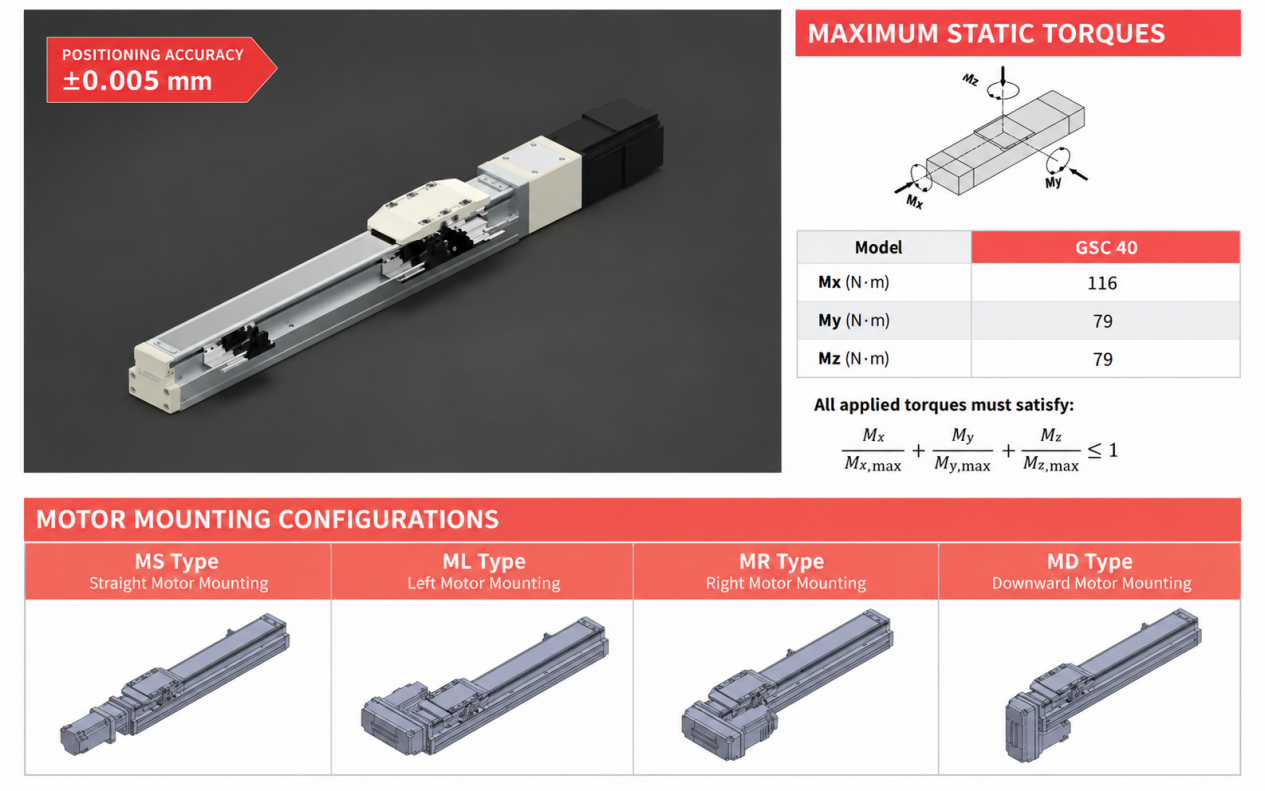
How it addresses the need: LIMON’s GSC series includes GSC40, with catalogue standard strokes of 50 to 800 mm in 50 mm steps and stated repeatability of ±0.005 mm. The listed maximum speed is 300 or 600 mm/s for the 6 or 12 mm screw lead; respective horizontal payloads are 20 or 12 kg and vertical payloads 8 or 3.5 kg.
| GSC 40 Basic Specification | ||||
| Technical Parameters | Repetitive Accuracy(mm) | ±0.005 | ||
| Ball Screw Lead(mm) | 06 | 12 | ||
| Maximum Speed(mm/s) | 300 | 600 | ||
| Maximum Payload | Horizontal(kg) | 20 | 12 | |
| Vertical(kg) | 8 | 3.5 | ||
| Rated Thrust(N) | 141 | 71 | ||
| Basic Specification | Stroke(mm) | 50-800 mm / 50 Pitch | ||
| AC Servo Motor Output(W) | 100 | |||
| Ball Screw Diameter(mm) | C7 Ø10 | |||
| Coupling(mm) | 7×8 | |||
| Home Sensor | PM-Y45(NPN) | |||
| #Note: The motor acceleration and deceleration time is set to 0.2s. | ||||
Fit limit: Select one lead and load column; do not combine their best values. Those figures do not establish absolute positioning accuracy, a common test result with Bosch or matching mounting holes. Motor and control selection must also be confirmed for the proposed configuration
YRO170—Bosch need and reason to compare
If a project’s longer travel, load orientation or proposed machine layout leads the OEM to reconsider its selected belt-axis architecture, a rack-driven option deserves a separate design review.
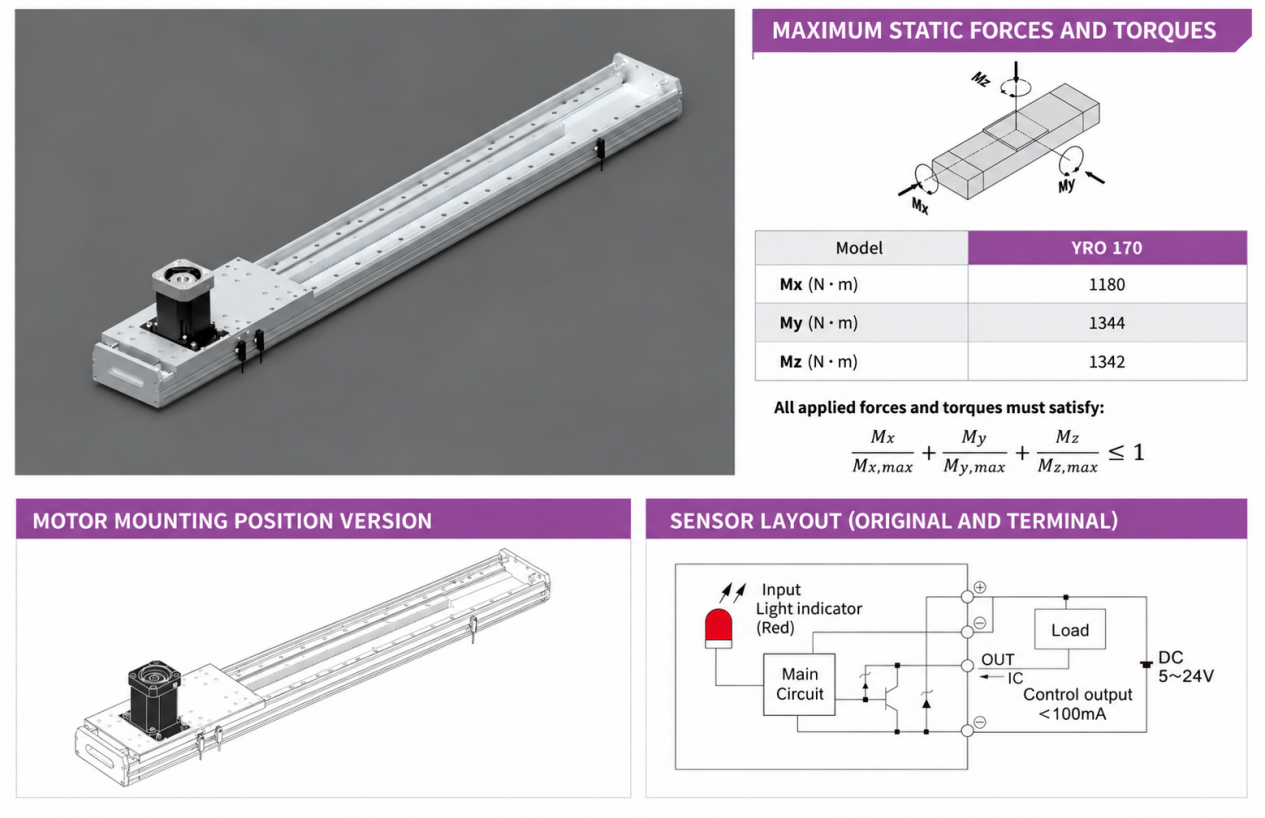
How it addresses the need: The YRO series includes YRO170. Its catalogue lists standard strokes of 900–5,500 mm in 100 mm steps. For its listed 13, 26 and 44 mm rack-and-pinion lead configurations, horizontal payload options are respectively 250, 135 and 85 kg; the corresponding vertical values are 60, 40 and 25 kg.
| YRO 170 Basic Specification | |||||
| Technical Parameters | Repetitive Accuracy(mm) | ±0.02 | |||
| Rack Lead(mm) | 13 | 26 | 44 | ||
| Maximum Speed(mm/s) | 650 | 1300 | 2200 | ||
| Maximum Payload | Horizontal(kg) | 250 | 135 | 85 | |
| Vertical(kg) | 60 | 40 | 25 | ||
| Reducer Speed Ratio | 10 | 5 | 3 | ||
| Rated Thrust(N) | 1133 | 566 | 340 | ||
| Basic Specification | Stroke(mm) | 900-5500 mm / 100 Pitch | |||
| AC Servo Motor Output(W) | 750 | ||||
| Linear Guide(mm) | W20×H19 | ||||
| Home Sensor | EE-SX672(NPN) EE-SX672P(PNP) | ||||
| #Note : Acceleration and deceleration value is set 0.2 second. | |||||
Fit limit: A belt-to-rack change is an engineered redesign, not a general MKR substitute or bolt-in retrofit. Validate offset load, speed, acceleration, gearbox, lubrication, mounting and motor/control settings. A vertical lift also needs a power-off holding and brake review.
Bring the duty to us with the downloadable catalogue and configuration drawing.
2.HIWIN: a broad configurable axis range
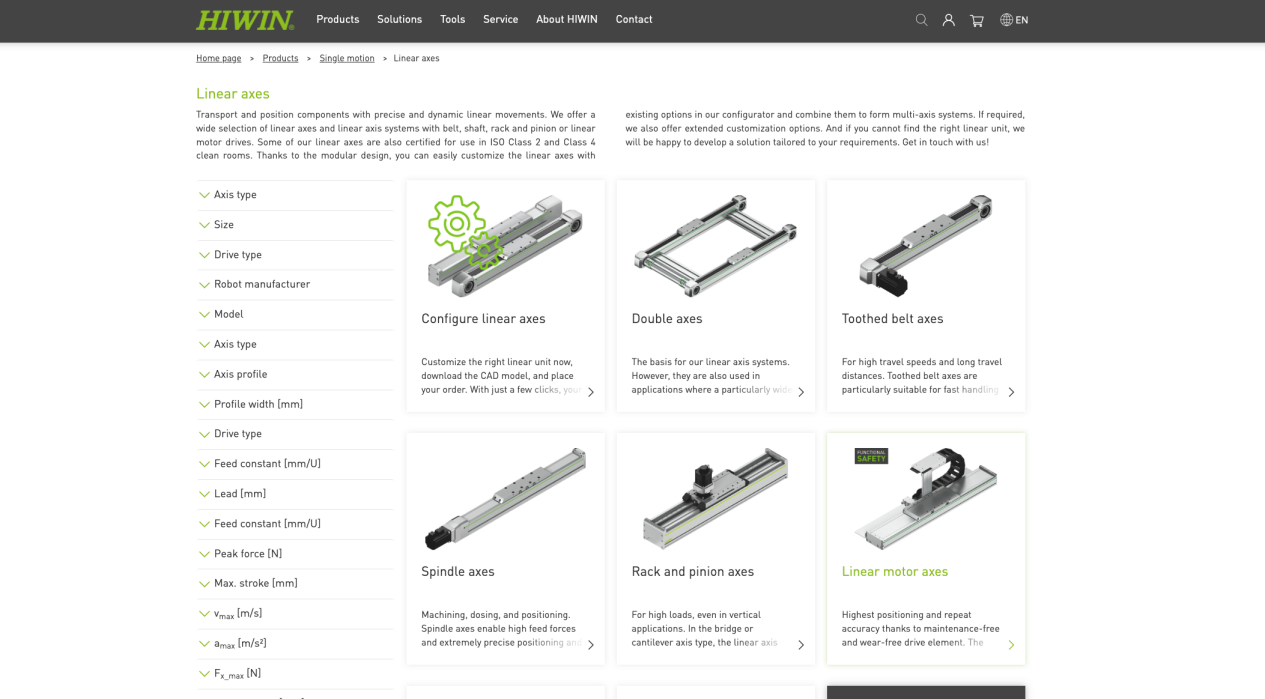
Bosch need and reason to compare: If the selected MKK or MKR meets the machine’s duty but you need a second complete-axis source, start with the corresponding screw or belt category. If the new duty has changed, HIWIN also offers rack and linear-motor categories.
How it addresses the need: HIWIN’s linear-axis portfolio separates these driven axes and provides configuration and CAD routes. That lets the buyer compare a *named assembly*, not just a rail brand.
Fit limit: A HIWIN spindle axis is a plausible functional comparison for a screw-driven Bosch axis, and a HIWIN belt axis for a belt-driven one; neither relationship proves the same base holes, carriage height, motor mount or controller connection. Request the configured drawing and sizing result before estimating retrofit work.
3. THK: compact screw actuators, with other families for different duties
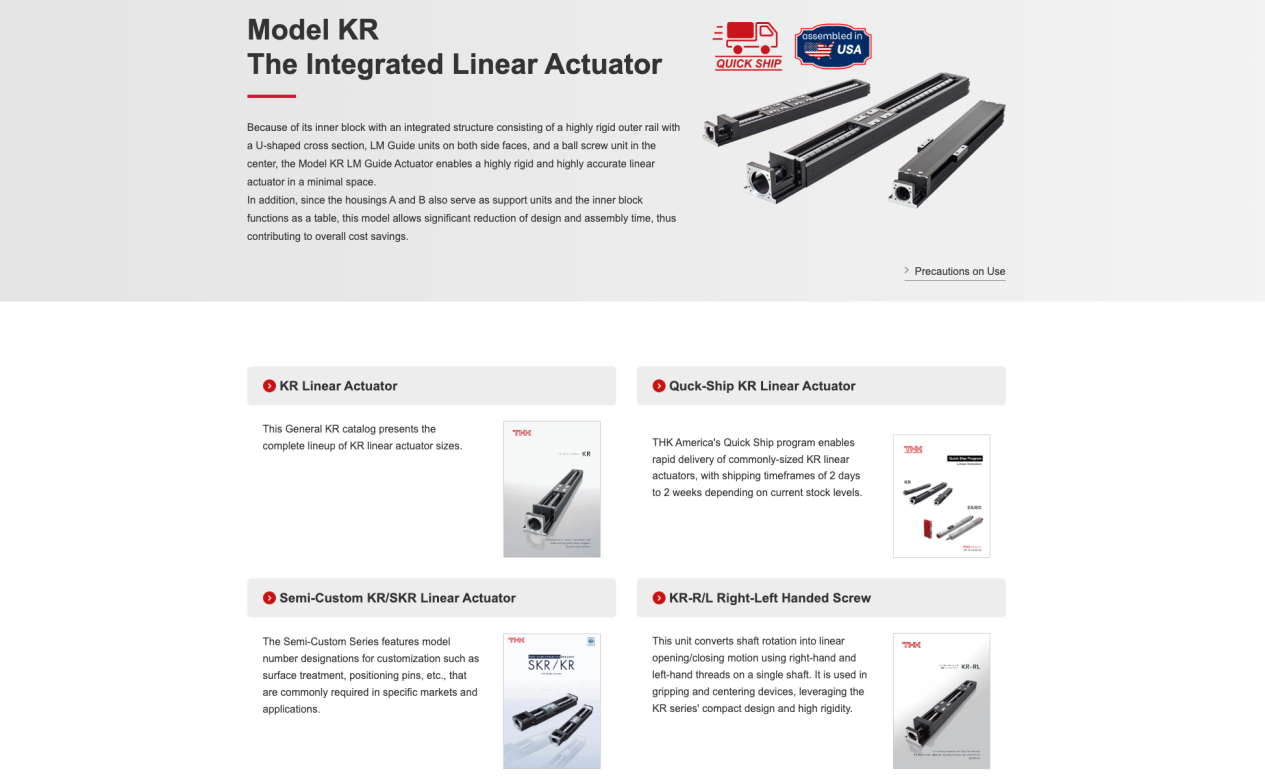
Bosch need and reason to compare: For MKK linear module alternatives, or a compact CKK-like screw duty, a buyer may want to retain guided screw motion while reconsidering the available installation space.
How it addresses the need: THK’s KR integrated actuator combines a ball screw and guide structure in a U-shaped body; KSF, GL-N and TH serve other stroke or load briefs.
Fit limit: KR’s integrated construction does not imply a Bosch mounting match. Check its selected stroke, moment ratings, moving-table height and motor bracket. If the original is a belt-driven MKR, replacing it with KR also changes the drive concept; shortlist a belt family instead unless that redesign is intentional.
4.Festo: electric axes when the automation package matters
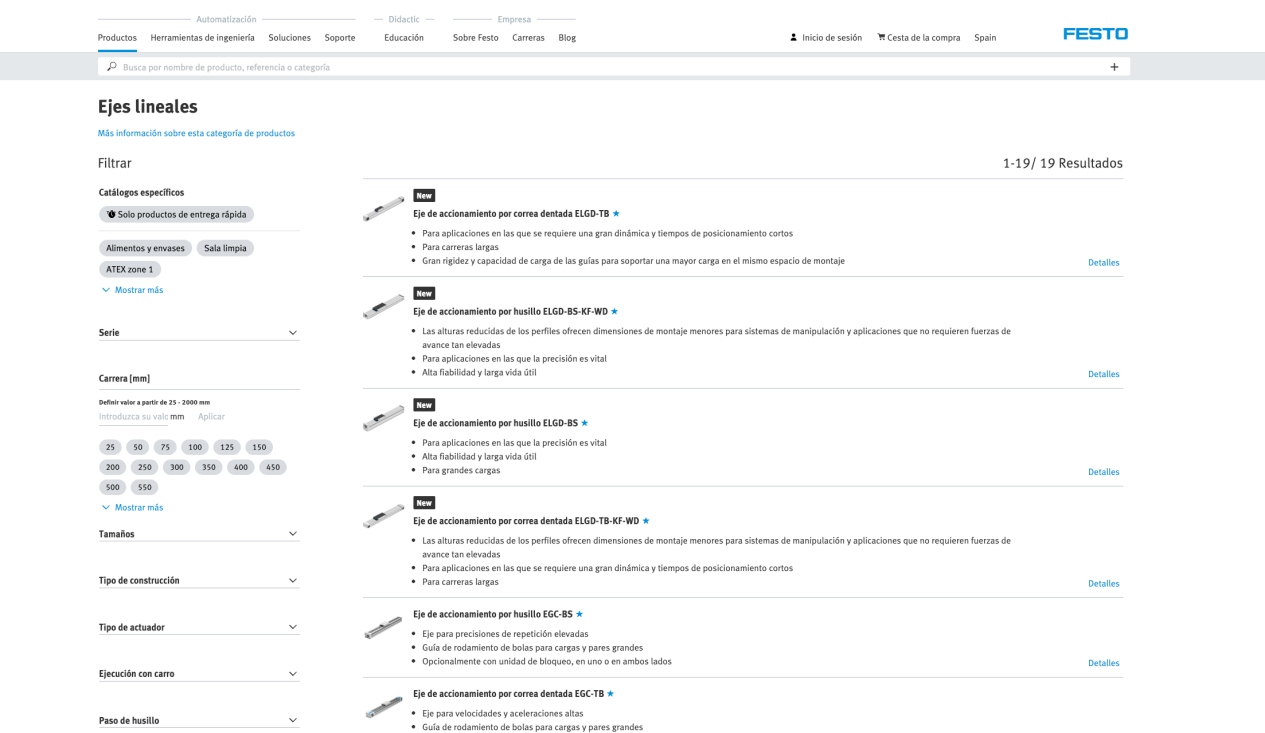
Bosch need and reason to compare: An OEM may want a screw or belt axis and a more explicitly specified motor-and-drive package.
How it addresses the need: Festo’s Spanish electric-axis range lists EGC-BS/ELGC-BS screw axes, EGC-TB/ELGC-TB belt axes and ELGS drive-unit options. This gives a route to compare both the mechanical axis and the automation package.
Fit limit: Those families are not interchangeable with one another, much less automatically with an MKK or MKR. Confirm whether the quoted motor, drive and controller are included, which PLC interface is offered and who rewrites homing and motion parameters. A mechanical match can still entail a controls redesign.
5. IAI: compact motorized slider actuators
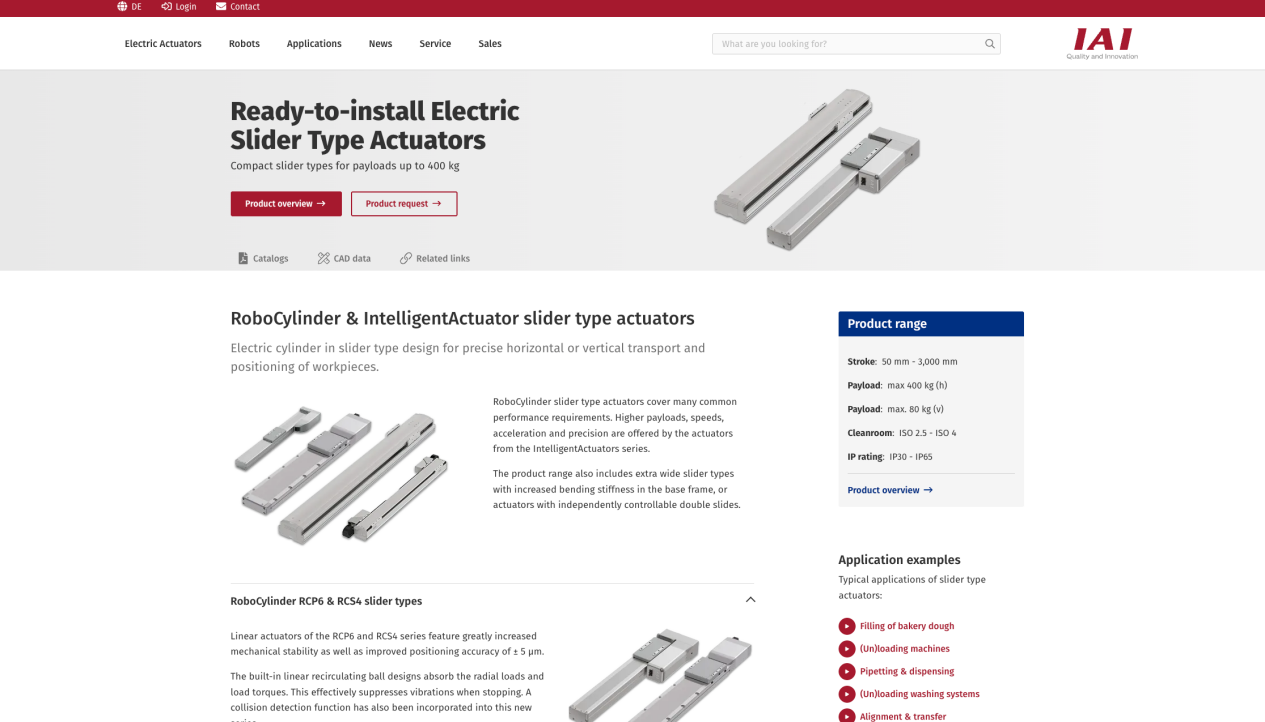
Bosch need and reason to compare: A compact, short-stroke MKK/CKK positioning task may call for a guided axis supplied with motor and feedback rather than a separately specified mechanical module and motor.
How it addresses the need: IAI’s RoboCylinder and IntelligentActuator slider types provide motorized carriage motion; its electric-actuator overview describes motor and encoder integration.
Fit limit: Controller arrangements differ among RoboCylinder, IntelligentActuator and EleCylinder. Select a slider actuator, then verify horizontal or vertical payload, stroke, PLC connection and envelope. A rod actuator’s thrust figure is not interchangeable with a Bosch carriage module’s payload rating, and a change of controller may require new wiring and code.
6.Rollon: belt axes and configured handling systems
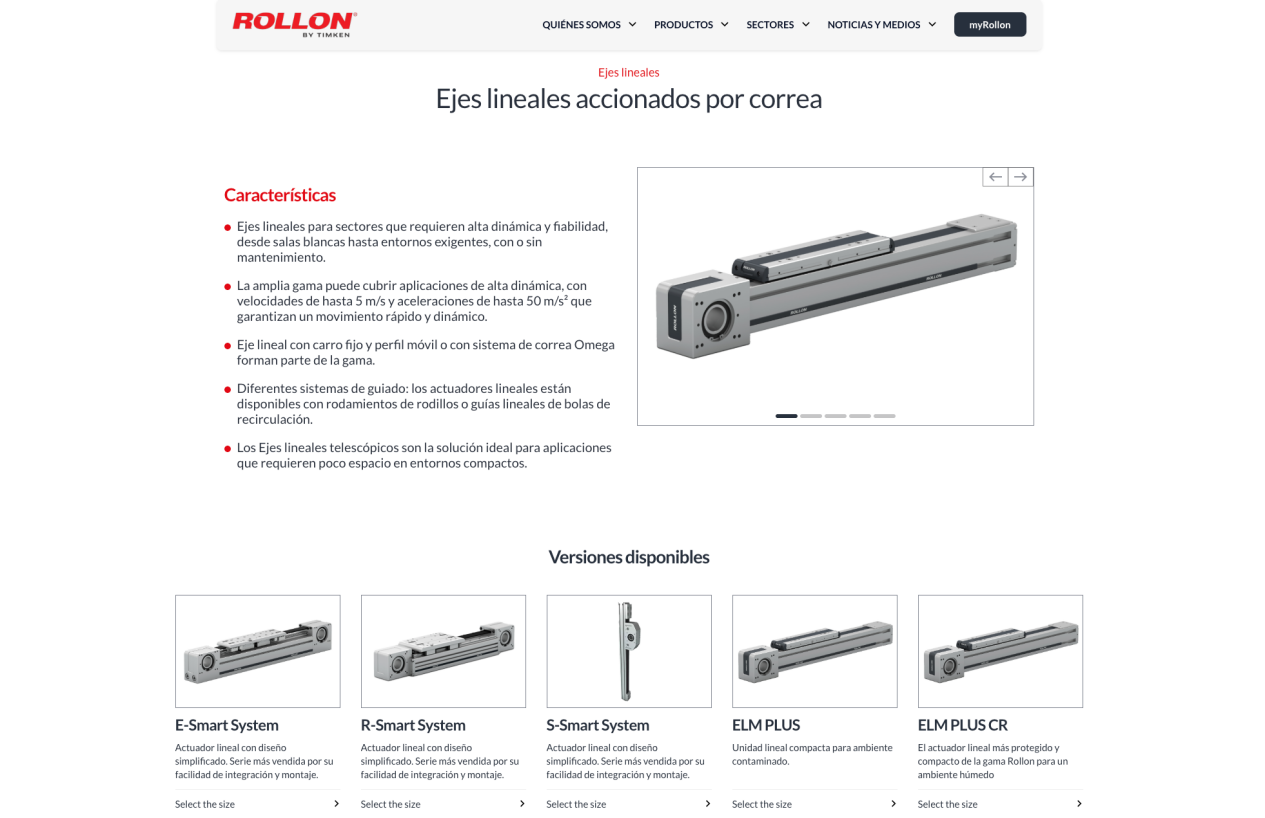
Bosch need and reason to compare: For MKR belt-driven linear axis alternatives, the buyer may be comparing a long-travel handling duty, a different supported-axis layout or a future XY arrangement.
How it addresses the need: Rollon’s Spanish belt-axis range includes guided E-Smart and R-Smart actuators, and its product center shows separate screw, rack and Cartesian families.
Fit limit: Choose the precise belt axis, carriage/profile arrangement and motor supply scope. A published travel maximum does not establish capacity at your payload offset, acceleration and duty cycle. Nor does a belt drive make the base pattern or carriage geometry match an MKR/CKR.
The OEM comparison matrix: what must match?
Use this before asking any supplier whether its axis is “equivalent.” When comparing Bosch Rexroth linear module alternatives, the Bosch axis table itself separates drive, travel and repeatability by family; one maximum cannot stand in for an entire assembled-axis specification. The useful question is whether a configured axis meets the same duty and mounting constraints.
| Decision field | What to record from the existing machine | What to request from each candidate |
| Drive | Full Bosch model and whether it is screw, belt or another type; screw lead or belt transmission where known. | Named complete-axis family and model, drive type, orientation and any proposed change to the motion concept. |
| Stroke and envelope | Usable travel, overall installed length, carriage height, end clearances, motor position and cable space. | Dimensioned drawing at the selected stroke, hard-stop limits and motor/gearbox layout. |
| Load and dynamics | Moving mass, workpiece offset, moments, horizontal/vertical orientation, speed, acceleration and duty cycle. | Sizing calculation for that exact orientation, moments, speed and life assumptions—not just a headline payload. |
| Precision terms | Required repeatability, absolute positioning accuracy, backlash and how/where each is measured. | The same metric, test method, travel and conditions. ISO 230-2 treats positioning accuracy and repeatability as different measured properties. |
| Controls and integration | Motor type, encoder, drive, PLC protocol, homing, limit sensors, brake and safety circuit. | Exact motor/drive/controller supply scope, pinout, wiring and responsibility for tuning and machine safety. |
| Procurement scope | Quantity, destination, required documentation, acceptance criteria and delivery window. | Part-numbered quotation, drawing/CAD, documents, Incoterm, lead time, warranty and support boundary. |
That distinction between linear module positioning accuracy vs repeatability is easy to miss. A repeatability number tells you how closely the axis returns to a commanded point under stated conditions; it does not by itself prove how close that point is to its true coordinate over the full travel. Likewise, the complete linear axis vs linear guide decision affects the entire bill of materials, not just a rail size.
How to choose between screw, belt and rack for this project
If you are comparing screw-driven MKK or CKK modules, shortlist complete screw axes first. That is the fastest way to narrow Bosch Rexroth linear module alternatives to the right mechanical category. Look at usable stroke, lead, thrust, vertical holding, speed and accuracy definition. The GSC40 is one compact candidate when its model-specific load and stroke fit; THK KR and Festo’s screw axes are other complete-axis families worth sizing. For long travel, check screw critical speed and support arrangement rather than assuming every screw module can simply be lengthened.
For a belt-driven linear actuator for OEM handling work, look at MKR/CKR requirements, then size the belt-axis families from HIWIN, Festo or Rollon. A belt axis can suit long, dynamic transfer, but load offset, deflection and repeatability still need to be checked at the chosen stroke. Where long travel and higher directional load point toward rack drive, compare a named rack axis such as YRO170 against the required layout; changing from belt to rack may alter noise, maintenance, motor sizing and controls parameters. Treat that as an engineering redesign until proven otherwise.
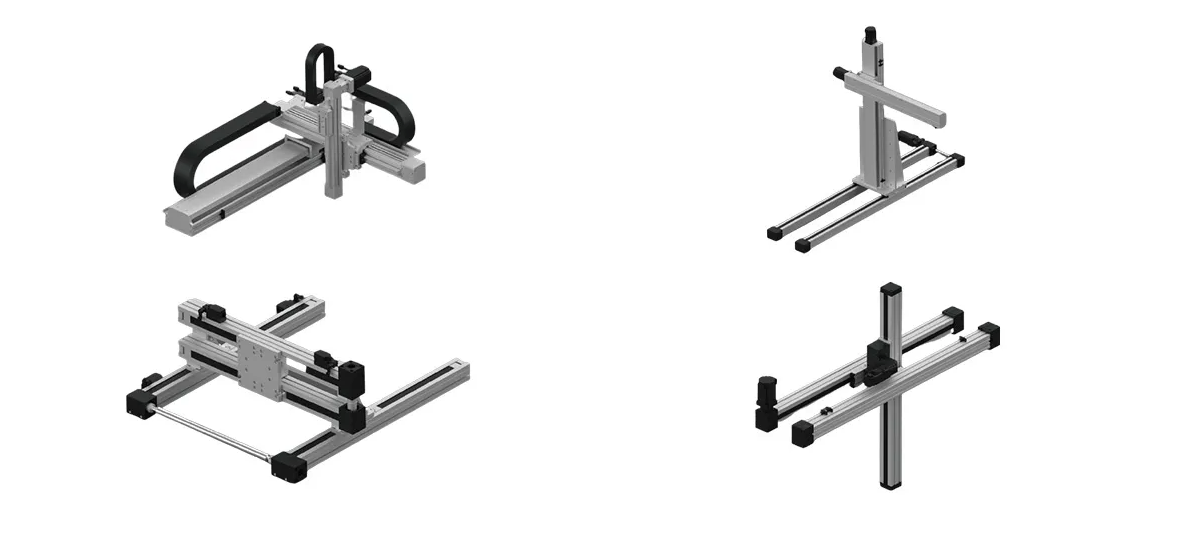
What if the machine needs XY or XYZ motion? Compare the single axes first, then the multi-axis system scope: support structure, axis stacking, cable management, shared loads and controls responsibilities all change. A matched X axis does not automatically make the whole gantry equivalent.
A practical linear module replacement checklist for Spain and export projects
Send suppliers the full old part number, a photo of its nameplate, machine drawing and the real working stroke. Add payload including tooling, center of gravity, orientation, cycle profile, required repeatability or positioning accuracy, environment, motor/drive details and the destination. If you need a specific PLC protocol or enclosure rating, say so before a model is selected. This is also where linear module motor controller compatibility gets settled: request the proposed motor, feedback device, drive, connector and communication details in writing.
For LIMON projects, our service process covers application-based selection and project discussion. We can discuss model-specific drawings and provide remote technical guidance; the exact motor, drive, documents, delivery and any on-site work belong in the written quotation. Standard axis supply does not by itself include machine mounting, PLC programming, on-site commissioning or machine-safety validation.
For a Spanish or other European delivery—or a US machine build—give us the destination and required documents so the export and support scope can be agreed before ordering. That written scope matters as much as the shortlist when assessing Bosch Rexroth linear module alternatives. Send your RFQ to LIMON.
FAQs
Can another brand’s module replace a Bosch Rexroth MKK or MKR without redesign?
Sometimes a candidate will fit the required function, but a drop-in claim needs a drawing-level check of stroke, envelope, carriage, holes, loads and motor/control connections. None of the six manufacturer family pages proves universal part-number interchangeability.
Which Bosch Rexroth linear module alternatives are best for a compact screw axis?
Start with a named screw-driven complete axis, then size it. THK KR, Festo EGC/ELGC screw axes, HIWIN spindle axes and LIMON GSC40 are relevant *families*; the correct model depends on the machine’s stroke, load, moments, orientation and interface.
Should I choose a belt, screw or rack axis for long travel?
There is no drive-type winner without the duty. Belt and rack families deserve a look for longer travel; a screw axis may be preferable when the force and positioning requirements fit its supported stroke. Compare the complete operating point—travel, moving mass, acceleration, duty and precision requirement—not the largest value on a family page.
The next step
The best Bosch Rexroth linear module alternatives are the axes that pass an application-specific check. Keep the original Bosch module as the benchmark, ask each supplier for a named complete-axis configuration, and compare the same duty and delivery scope. If GSC40 or YRO170 looks relevant, share your drawing and duty cycle with LIMON for a model-specific selection and quotation.