LIMON is one option among the companies an OEM should consider for configurable multi-axis linear motion systems. The right shortlist depends on what you are building: a Cartesian handling machine, a precision inspection stage, or a subsystem that arrives with drives and much of the integration work already done. For project-configured axes and precision platforms, start with LIMON; for standardized Cartesian robots, look closely at IAI; for ready-to-install handling, Bosch Rexroth and Festo deserve attention. HIWIN and Rollon are strong comparisons for modular gantries, while Aerotech belongs on a precision-focused shortlist.
That is a starting point, not a universal ranking. Two suppliers can both offer “XYZ motion” while quoting very different things. One may supply a mechanical axis assembly. Another may include motors, drives, cable management, controls, and commissioning support. Before you compare names, define the machine you need.
Configurable Multi-Axis Linear Motion System Companies at a Glance
When comparing configurable multi-axis linear motion systems, use the published architecture to decide who deserves an RFQ—not to declare a winner before the machine requirements are known.
| Company | Project fit to investigate | Published system evidence | First question to ask |
| LIMON | Project-configured OEM XY/XYZ motion assemblies and custom precision platforms | Multi-axis systems, solution configurations, and documented belt-, ball-screw-, and linear-motor-based combinations | Which axes, drive hardware, drawings, and integration tasks are included in this quote? |
| Bosch Rexroth | Predefined 1D/2D/3D Cartesian subsystems for positioning and handling | Axis-combination table, LinSelect, 3D configuration, and optional electrical drive package | Which standard layout fits the envelope, and what is delivered assembled? |
| Festo | Ready-to-install 2D/3D handling gantries | Linear, planar, and three-dimensional gantry families with matched drive options | Does the quoted package include the exact motor, servo drive, and energy supply needed? |
| IAI | Catalogued Cartesian robots where model-level choices matter | 2- to 6-axis families, model tables, CAD, data sheets, and controller links | Which model and controller combination meets the working envelope and cycle? |
| HIWIN | Modular multi-axis systems configured from published axis families | Three-axis systems, millimetre-step stroke selection, CAD, and configurator | What is the exact X/Y/Z axis composition and installation package? |
| Rollon | Modular XYZ gantries for pick-and-place and packaging machinery | Multiple XYZ variants, drive choices, CAD downloads, and selection tools | Which variant meets the actual payload, acceleration, and maintenance plan? |
| Aerotech | High-precision XY gantries for inspection and processing | Direct-drive gantry families, motion-control features, and custom system options | What positioning and settling performance can be demonstrated at the work point? |
How this shortlist was built
Each company above publishes a system-level offering that is relevant to at least one part of the question. That matters. Searching for Cartesian robot manufacturers will also surface excellent component suppliers, but a rail catalog alone does not establish that a company can supply a configurable Cartesian system. Nor does a general warehouse-automation integrator automatically belong in the same RFQ as an axis manufacturer.
The comparison also avoids treating a stated maximum as a whole-machine guarantee. Stroke, load, acceleration, mounting direction, and end-effector mass interact. A useful supplier should be able to review the *combination*, not merely point to the largest number in a catalog.
That is especially important for multi-axis gantry systems: the structure and moving mass change as you add a bridge, a vertical axis, or a second carriage.
Which Companies Fit Cartesian, Precision, and Handling Projects?
Cartesian gantries and OEM machine axes
LIMON — for a defined machine envelope and project-configured hardware.
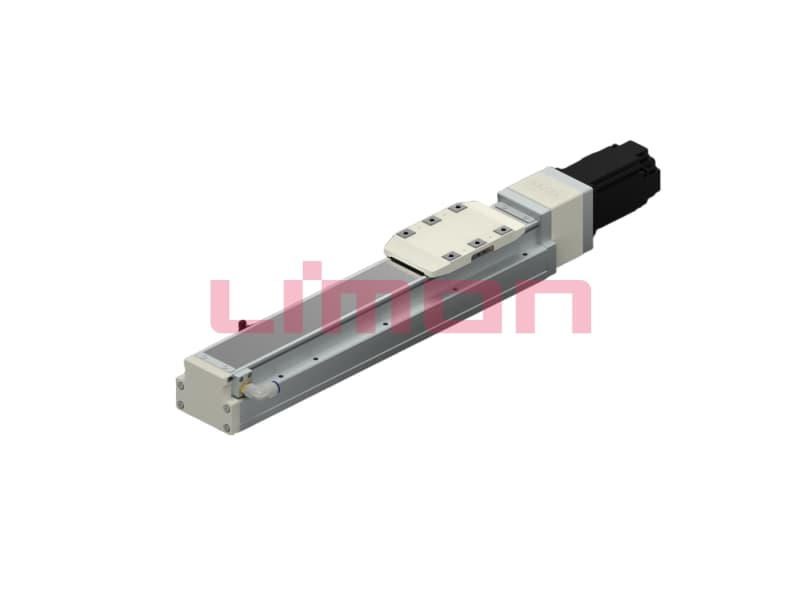
Our multi-axis system range covers project selection and axis combinations. Our catalog includes belt-driven XYZ combinations such as Ixyz60 and Ixyz80, ball-screw-driven Yxyz110 and Yxyz135 combinations, plus brackets, adapter plates, and other mounting elements. These are documented starting configurations, not a promise that every axis can be combined in every orientation.
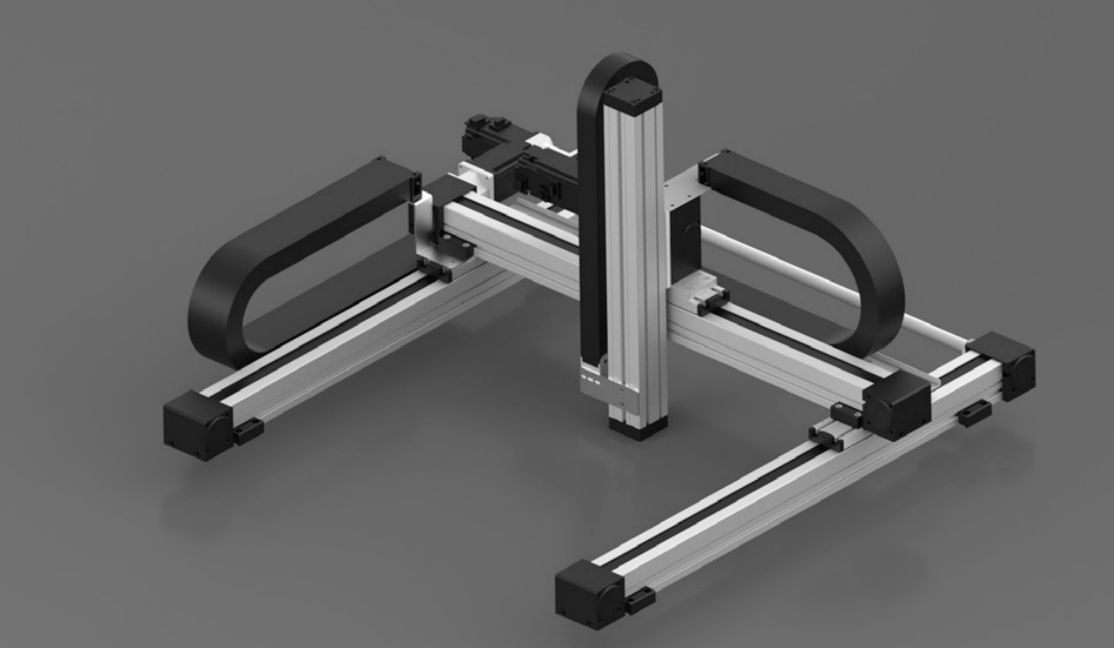
| Parameter | Ixyz60 | Ixyz80 | ||||
| X Axis | Y Axis | Z Axis | X Axis | Y Axis | Z Axis | |
| Axis Composition | ITO60 | ITO60 | ITZ60 | ITO80 | ITO80 | ITZ80 |
| Repetitive Accuracy(mm) | ±0.05 | ±0.05 | ±0.05 | ±0.05 | ±0.05 | ±0.05 |
| Driving Method | Belt | Belt | Belt | Belt | Belt | Belt |
| Max Speed(mm/s) | 2000 | 2000 | 1000 | 2000 | 2000 | 1000 |
| Max Stroke(mm) | 4000 | 1500 | 1000 | 4000 | 2500 | 1000 |
| Max Transport Load(kg) | 5kg | 12kg | ||||
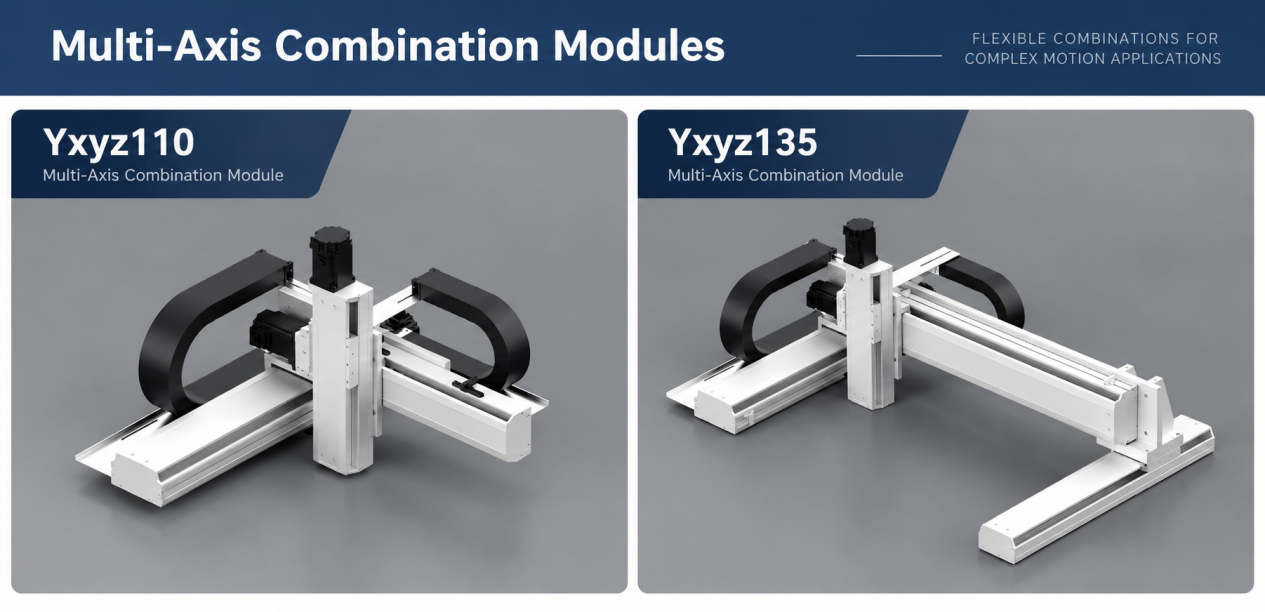
| Parameter | Yxyz110-XB | Yxyz135-XB | Yxyz110-LM | Yxyz135-LM | |||||||||
| X Axis | Y Axis | Z Axis | X Axis | Y Axis | Z Axis | X Axis | Y Axis | Z Axis | X Axis | Y Axis | Z Axis | ||
| Axis Composition | GSC80 | GSC80 | GSC50 | YSO135 | YSO135 | GSC80 | GSC80 | GSC80 | GSC50 | YSO135 | YSO135 | GSC80 | |
| Repetitive Accuracy(mm) | ±0.01 | ±0.01 | ±0.01 | ±0.01 | ±0.01 | ±0.01 | ±0.01 | ±0.01 | ±0.01 | ±0.01 | ±0.01 | ±0.01 | |
| Driving Method | Ball Screw | Ball Screw | Ball Screw | Ball Screw | Ball Screw | Ball Screw | Ball Screw | Ball Screw | Ball Screw | Ball Screw | Ball Screw | Ball Screw | |
| Max Speed(mm/s) | 1000 | 1000 | 500 | 1000 | 1000 | 500 | 1000 | 1000 | 500 | 1000 | 1000 | 500 | |
| Max Stroke(mm) | 1050 | 450 | 250 | 1250 | 550 | 350 | 1050 | 650 | 250 | 1250 | 550 | 350 | |
| Z Axis Stroke | Z Axis Stroke | Z Axis Stroke | Z Axis Stroke | ||||||||||
| Y Axis Stroke | 150 | 250 | – | 150 | 250 | 350 | 100-250 | 100-350 | |||||
| Max Transport Load(kg) | 150mm | 5kg | 5kg | – | 10kg | 10kg | 9kg | 150-650 mm 5kg | 150-650 mm 15kg
| ||||
| 250mm | 5kg | 5kg | – | 9kg | 8kg | 7kg | |||||||
| 350mm | 5kg | 5kg | – | 9kg | 6kg | 5kg | |||||||
| 450mm | – | – | – | 5kg | 4kg | 3kg | |||||||
| 550mm | – | – | – | 3kg | 2kg | 1kg | |||||||
For an OEM with an unusual footprint or a choice between transmission methods, we review the drawing, moving mass, duty cycle, and supply scope before specifying the assembly. Our linear module families show the broader drive range.
HIWIN — for a modular, configuration-led route.
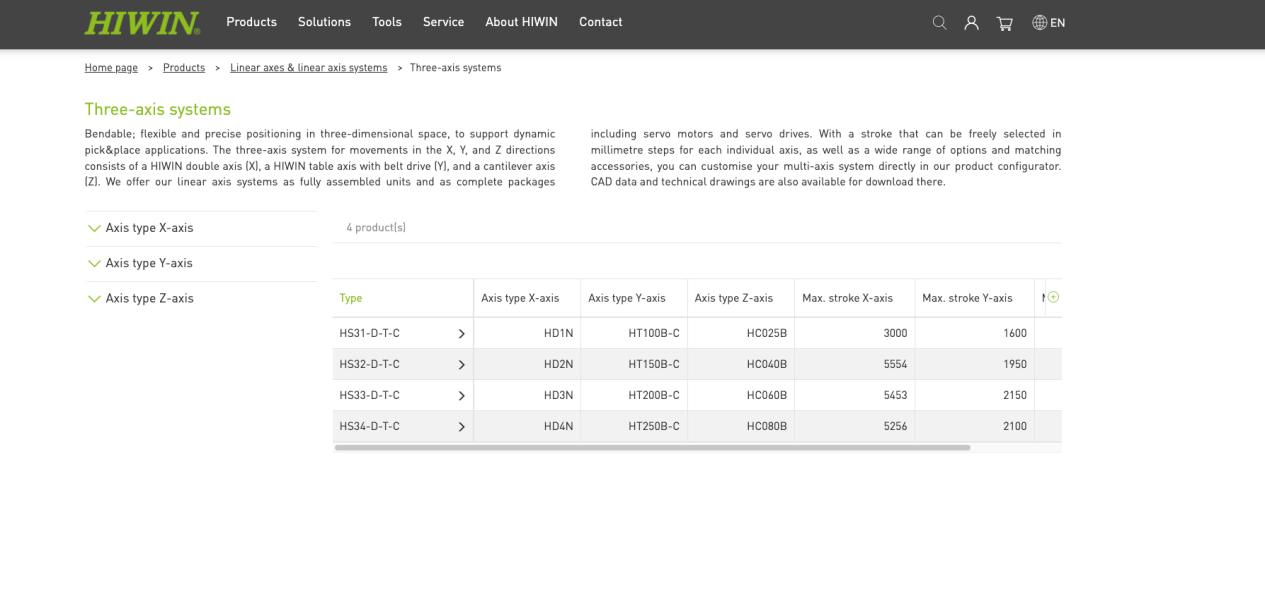
HIWIN’s three-axis systems combine a double X-axis, belt-driven Y-axis, and cantilever Z-axis. Its published configurator allows stroke selection and CAD downloads. That is useful when an OEM wants to explore a catalogued axis architecture before asking for a special layout. Check the exact axis series, stroke, accessory package, and motor/drive scope rather than comparing “three axes” as though they were identical.
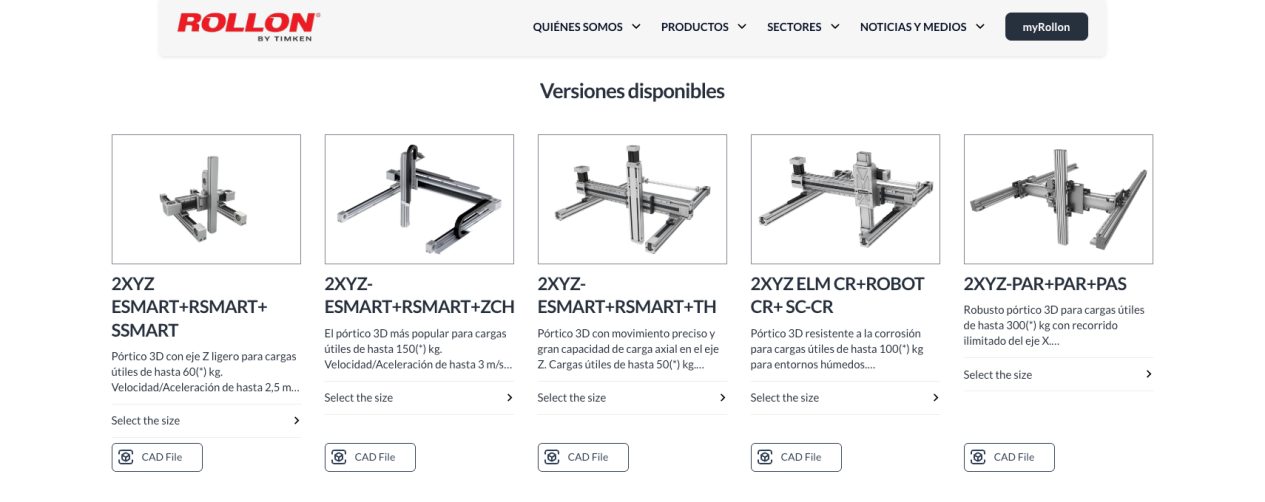
Rollon — for modular XYZ and packaging-style pick-and-place layouts.
Rollon’s XYZ range groups gantries by configuration and gives product-level performance and CAD routes. Its Rollon–Dexis packaging project is a useful example of how a modular axis family can be adapted around an OEM’s palletizer requirements. It is one project, not proof that a quoted Rollon system will match yours. Ask for the specific variant and the assumed box mass, gripper, cycle, and service
Precision XY stages and inspection platforms
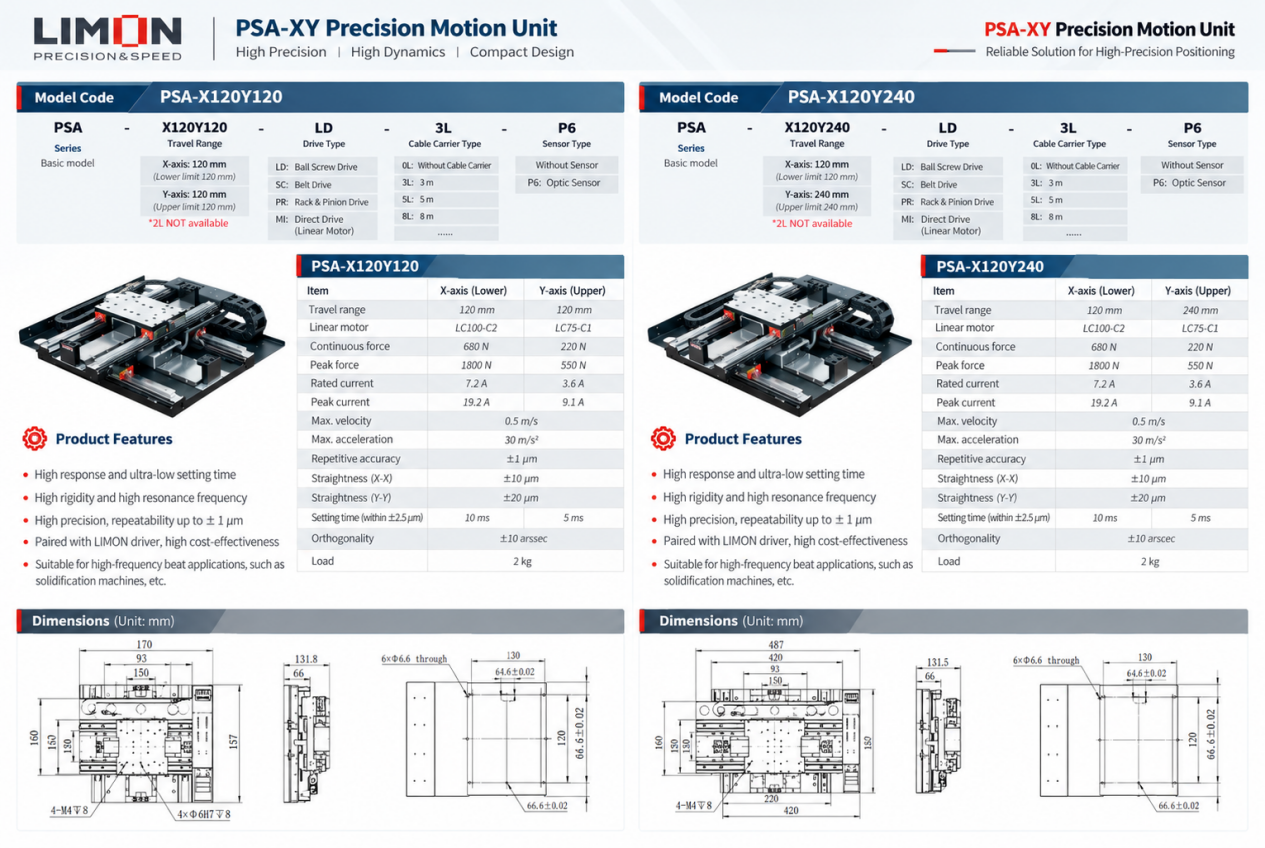
LIMON — for a custom precision-platform. Alongside multi-axis assemblies, we develop project-specific precision platforms. The current direct-drive catalog shows a PSA-XY precision motion unit with two linear-motor axes and defined X/Y travel options; it also depicts moving-bridge, fixed-bridge, and crossed-stage platform layouts. Those examples establish design directions, not one universal accuracy claim. For a camera-inspection or wafer-handling machine, repeatability, absolute positioning accuracy, straightness, orthogonality, vibration, and settling time must be specified separately, at the relevant stroke and payload. We will scope those values against the actual project configuration.
Aerotech — for a precision-first gantry and control package. Aerotech’s gantry systems cover direct-drive XY platforms for inspection, precision assembly, and laser processing, together with coordinated motion-control features. It is a sensible comparison when work-point accuracy and synchronized motion dominate the decision. Ask for the test conditions and acceptance method: “micron-level” in a product description is not enough to qualify your process.
Integrated handling and standardized Cartesian robots
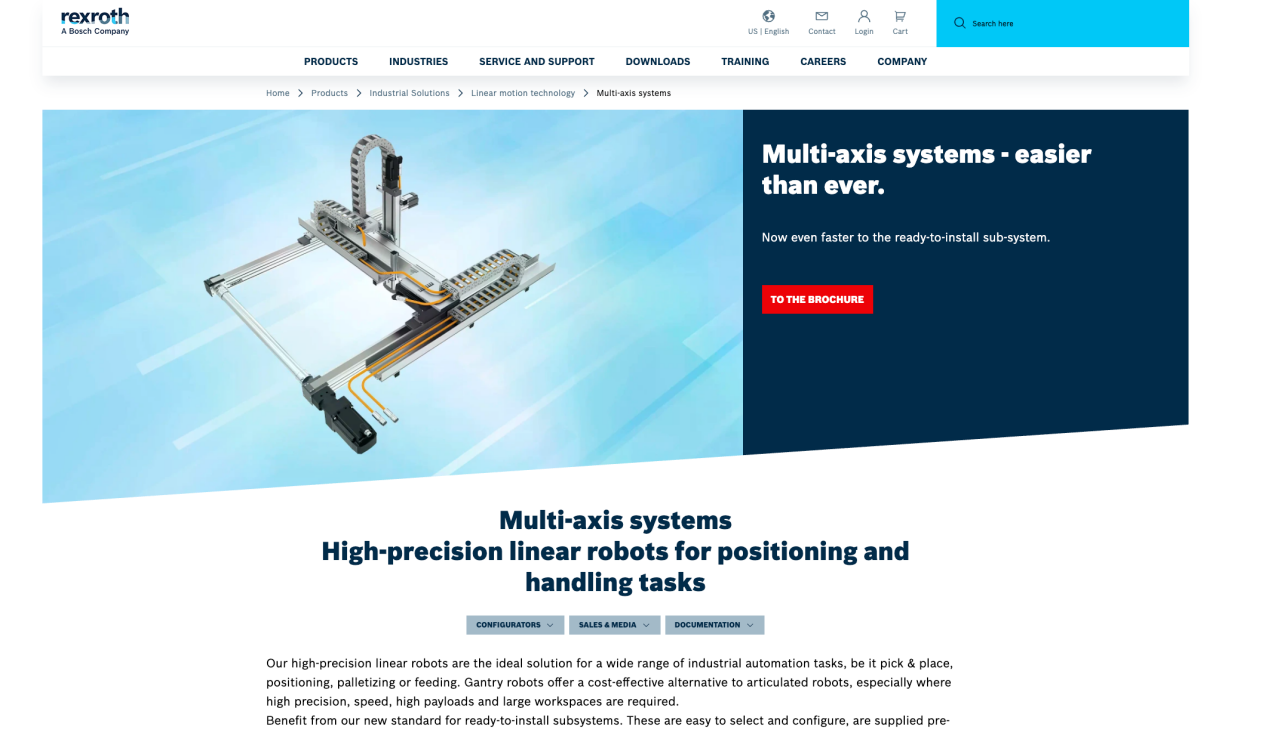
Bosch Rexroth — for a predefined, assembled multi-axis subsystem. Bosch Rexroth publishes 1D, 2D, and 3D combinations and describes a ready-to-install mechanical package with optional electrical components. If your handling cell fits one of those architectures, its selection and configuration path can reduce early layout ambiguity. Confirm the quoted axis set, controller interface, energy chain, and where your machine builder takes over.
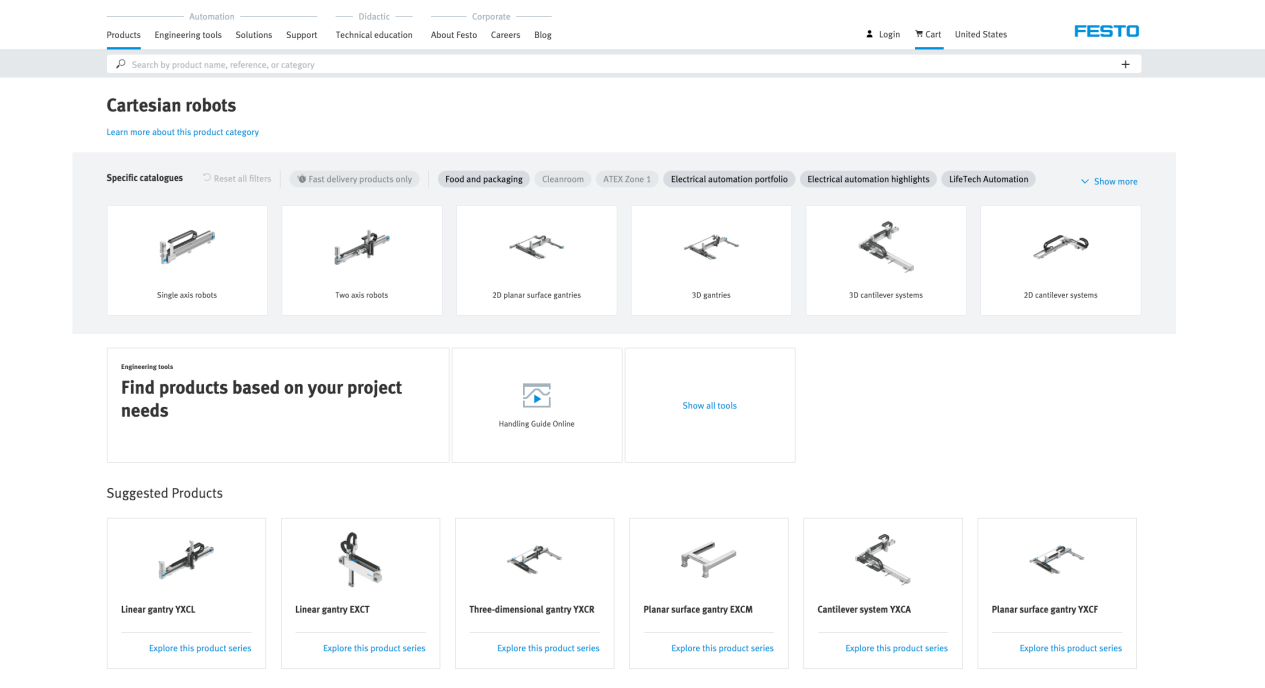
Festo — for coordinated handling hardware. Festo’s Cartesian robot range distinguishes single-axis, linear gantry, planar gantry, and 3D gantry layouts. The published packages pair mechanical axes with motors, drives, and energy supply options. For a pick-and-place cell, that system scope can matter more than comparing actuator specifications one by one. Check whether the chosen pneumatic/electric mix, gripper, controls, and on-site tasks are actually included.
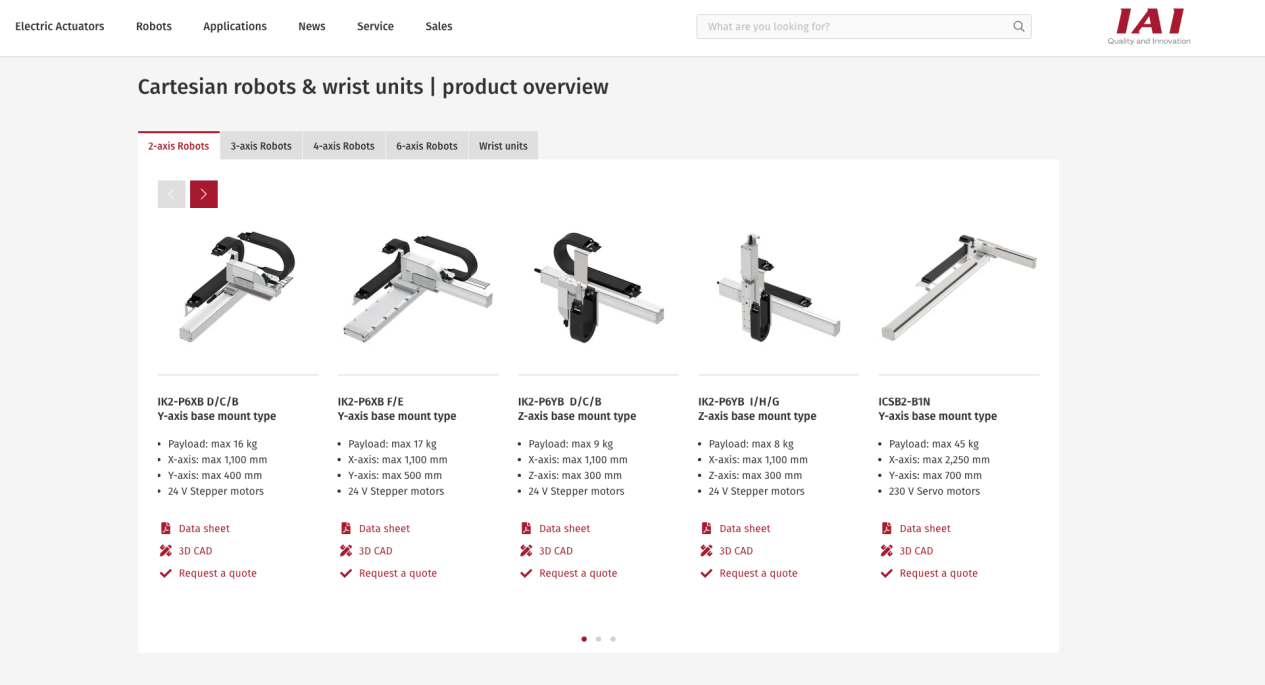
IAI — for a model-driven Cartesian robot selection. IAI publishes 2- to 6-axis Cartesian families with model-by-model stroke and payload information, CAD, data sheets, and controller references. This is a practical route when the application can be described against a standard combination. Ask how the selected robot, controller, field network, cables, and safety interfaces will meet the machine’s cycle and plant standards.
The useful comparison among these configurable multi-axis linear motion systems is therefore *project fit*: how closely a published layout matches your machine, and how much engineering remains after delivery.
For a narrower component question, our Bosch Rexroth linear module alternatives for OEMs compares linear-module sourcing rather than complete multi-axis systems.
How to Choose a Supplier for Your Actual Motion Task
1.Define the work envelope before the brand
Is this a flat XY positioning table, an overhead portal, a vertical XZ handler, or an XYZ space gantry? Map the usable stroke on each axis, the clearance around the tooling, and the mounting surfaces. A custom XY gantry system can fail the project before motion tuning starts if the bridge blocks access to the workpiece or the Z-axis leaves too little safe travel.
For configurable multi-axis linear motion systems, the requested usable stroke is more useful than the longest stroke printed in a catalog.
2.Calculate the moving load, not just the part weight
Include gripper, cables, sensors, carrier, and any moving tooling. Then state the installation direction, moments, acceleration, and duty cycle. A vertical Z-axis also needs a power-off holding decision. A catalog’s horizontal-load figure cannot simply be transferred to a vertical lift. For an XYZ gantry for material handling, the end effector and acceleration profile may drive the choice more than the carton weight alone.
3.Separate accuracy from repeatability
Repeatability asks whether the system returns to the same point. Absolute positioning accuracy asks how close it gets to the commanded coordinate. PI’s precision-motion metrology guide also separates straightness and angular errors from those two figures. Orthogonality, thermal behaviour, and settling time add further limits in inspection. If you are comparing a precision XY stage manufacturer with a general handling supplier, request the same measurement span, load, speed, temperature, and test method. Otherwise, attractive numbers can describe different tests.
4.Match the drive to the job
The belt-driven vs ball-screw gantry question has no one-line answer. Belt drives can be attractive for long, fast travel; ball-screw axes are often considered where thrust and positioning control are central; rack-and-pinion and linear-motor axes have their own long-travel or high-dynamics roles. Packaging, inspection, and vertical lifting can lead to different decisions. Start with the required speed–load–stroke combination, then size the full axis. For the screw-specific trade-off, see our ball-screw lead and speed guide.
5.Compare the delivered boundary
This is where many multi-axis linear actuator suppliers become difficult to compare. Does the quote cover only axes and drawings, or an assembled frame, motor, drive, cable management, controller, software, installation, and acceptance test? Request a responsibility list for each item. The cheapest mechanical quote and the most complete ready-to-install package are not equivalent offers.
6.Check how the system will be supported
Ask for current drawings, manuals, model-specific compatibility information, replacement-part identifiers, and the service route in the destination country. In Spain, language and on-site responsibilities should be confirmed in the order; a European customer reference alone does not prove local commissioning coverage. AER Automation’s 2026 industry survey identifies IT/OT integration and technical skills as industry barriers, which makes interface documentation a practical procurement question. The survey is a sector signal, not a forecast for this product category.
Where LIMON’s Engineering and Delivery Boundary Sits
Our strongest fit is an OEM linear motion system whose mechanical configuration has to be worked through with the machine designer. We can discuss belt-, ball-screw-, rack-and-pinion-, and linear-motor-driven axes; select components and mounting parts for a project; and develop a custom multi-axis precision platform. The documented catalog combinations and multi-axis system page are the first reference points. The final drawing and quotation define the supplied unit.
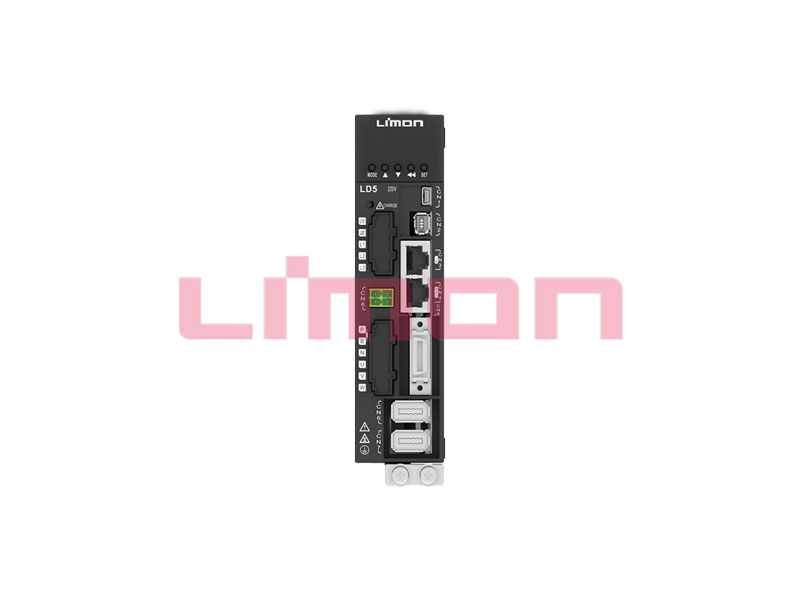
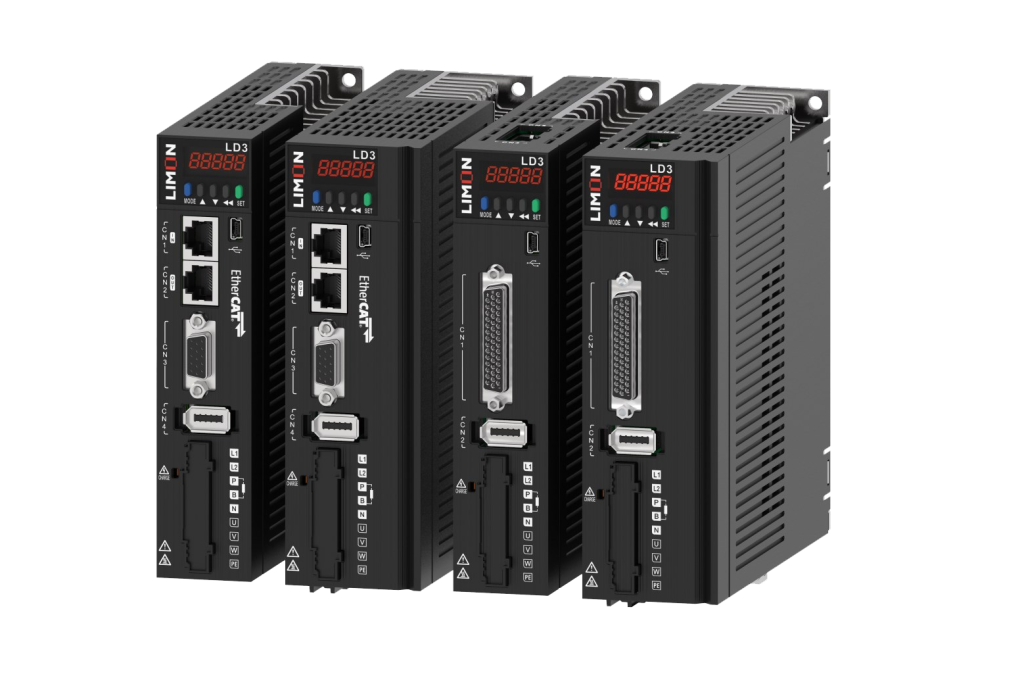
For a standard module or drive order, our deliverable is the ordered motion hardware and applicable technical documents. We can provide model selection input, drawings where available, installation guidance, and drive-wiring information for the specified product. Machine-level mechanical and electrical integration, PLC programming, safety devices, cycle-time tuning, and on-site calibration remain with the OEM or integrator unless separately agreed.
For a custom precision platform, the delivery model can be different. A project may be scoped as a platform assembly with drives and documents, a joint commissioning arrangement, or a more complete integration package. Scope, destination support, acceptance tests, and cost have to be agreed in writing for that project. If you need a ready-to-install Cartesian robot with a particular controller, do not assume a component quotation includes that system.
Comparing configurable multi-axis linear motion systems fairly means putting that delivery boundary next to the performance numbers. Ready-to-install Cartesian robots and project-specified motion assemblies can both fit an OEM program, but they create different work for the integrator.
There is also no blanket precision or payload figure for every LIMON combination. A catalog value for one series, direction, or test condition is not a specification for all gantries. That is why we ask for the application before recommending a configuration.
Send One RFQ That Every Supplier Can Answer
A disciplined RFQ makes configurable multi-axis linear motion systems easier to compare. Give each supplier the same task and ask them to identify exceptions, rather than letting every quotation assume a different machine.
| Send with the RFQ | Why it matters |
| Application and sketch or STEP/IGES/DXF drawing; required XY, XZ, or XYZ layout | Establishes the machine envelope, mounting interfaces, and collision constraints |
| Actual usable stroke on each axis, installation direction, and available space | Prevents sizing from a catalog maximum that the machine cannot use |
| Payload including tooling and moving mass; acceleration, maximum speed, takt time, and duty cycle | Allows a realistic drive, bearing, and structural review |
| Repeatability and/or absolute accuracy target, with measurement conditions | Prevents unlike precision claims from being compared as equals |
| Environment: temperature, dust, humidity, cleanroom or contamination requirement | Determines protection and documentation needs for the exact configuration |
| Motor, drive, controller/PLC, field network, cable, encoder, and power-off brake preferences | Exposes interface and vertical-axis holding requirements early |
| Quantity, sample needs, destination, desired delivery date, and preferred Incoterm | Lets the supplier scope the commercial and logistics side |
| Requested documents and responsibility split: drawings, inspection, installation, commissioning, and acceptance | Makes the quoted package comparable |
If you are ready to discuss a LIMON project, send the application details to our team. We will confirm the configuration and supply boundary in the written quotation.
FAQs
What is the difference between a Cartesian robot and a multi-axis linear system?
A Cartesian robot is a multi-axis system organized around linear X, Y, and often Z coordinates. “Multi-axis linear system” is broader: it can describe a precision XY stage, a gantry, or a custom arrangement of axes. The meaningful distinction for buyers is what the quoted assembly includes. Festo’s Cartesian overview shows several 2D and 3D layouts under one category.
Which company is best for a configurable XYZ gantry
Start with the project type. Bosch Rexroth, Festo, HIWIN, Rollon, IAI, and LIMON all publish relevant system or configuration routes, but their standard scope differs. For precision inspection, Aerotech and a project-configured LIMON platform may be worth comparing as well. Among configurable multi-axis linear motion systems, ask each supplier for an exact configuration and acceptance conditions; there is no responsible universal winner.
Can an OEM buy just the multi-axis mechanics?
Often, yes, but the supplier’s package matters. A mechanical assembly, a drive-equipped subsystem, and a commissioned machine are different purchases. Our standard component orders do not include full-machine PLC integration or on-site commissioning unless that work is specifically contracted. Ask every supplier to mark what is included.
Does higher repeatability always mean a better gantry?
No. A quoted repeatability value may say little about absolute accuracy, straightness across travel, dynamic settling, or the work point under load. For inspection and precision assembly, define the process tolerance first, then ask for the test setup behind each number.
What should a buyer in Spain check beyond the axis specifications?
Confirm the exact shipping destination and terms, technical-document language, who performs installation and machine safety work, how spare parts are identified, and whether on-site help is available for the project. Those items belong in the quote. Global industrial-robot installation figures are useful context, but they do not establish that any supplier has local support: the IFR’s World Robotics 2026 release reports about 4,300 industrial-robot installations in Spain in 2025, down 15% year on year; it does not measure Cartesian-system demand.
Conclusion
The best companies for configurable multi-axis linear motion systems are the ones that can show an exact system, a credible engineering path, and a clear delivery boundary for your machine. Use the seven names here to build a first shortlist by project fit: modular Cartesian or gantry, precision platform, or integrated handling. Then send the same RFQ to the relevant candidates and compare the resulting drawings, performance conditions, interfaces, and responsibilities.
For configurable multi-axis linear motion systems, a well-scoped quotation is more informative than any generic “best brand” list.
If your OEM project calls for a configured XY/XYZ assembly or a custom precision platform, talk to LIMON about the application. Bring the motion envelope and the real moving load. Those two details make the conversation much more useful.