Choose an open linear bushing when its opening must pass over a continuously supported shaft’s pedestal. A closed bushing surrounds the shaft and is commonly used where the bearing does not need to cross such a support. The shaft support, bearing opening, housing and load direction must be selected together.
Open and closed describe bearing construction, not simply whether a seal is present. An open bearing is not a closed bearing with its seals removed, and an adjustable bearing’s narrow slit is not necessarily a clearance opening for a shaft support.
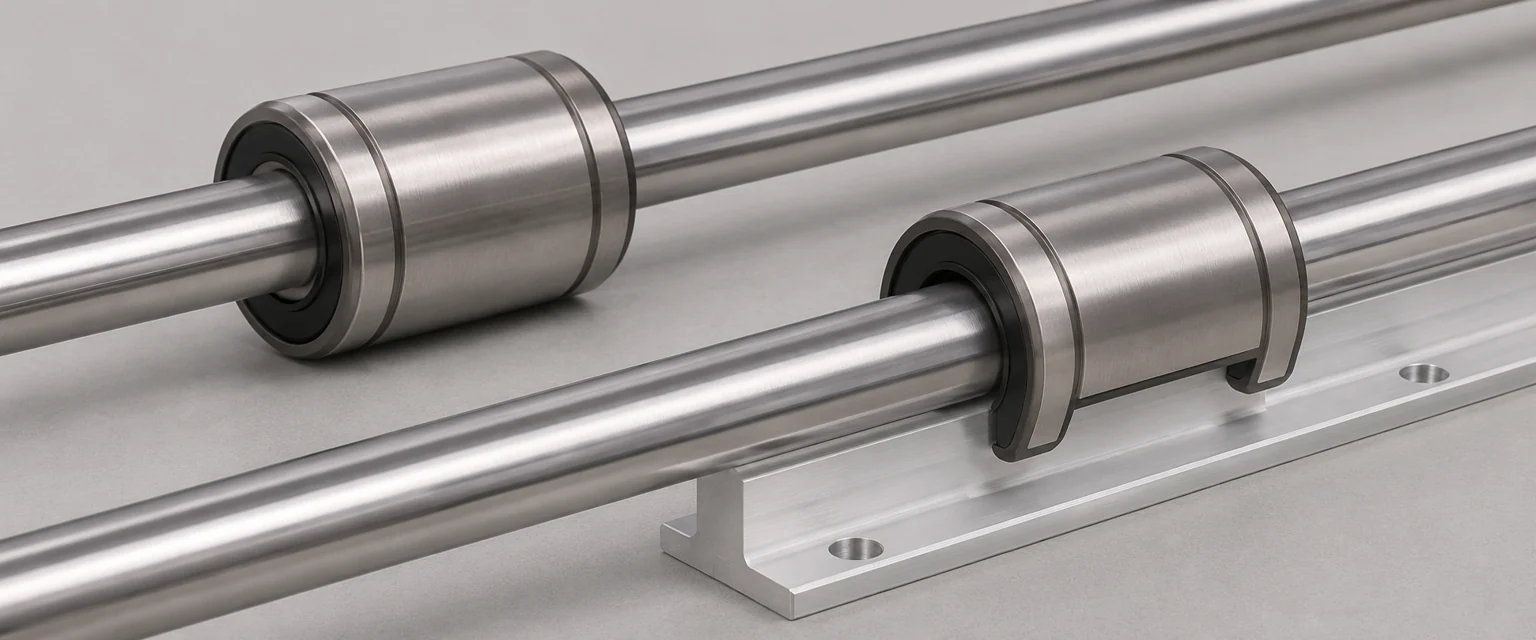
Let the shaft arrangement define the first choice
A shaft supported only at its ends leaves a clear cylindrical path for a closed bushing, but its bending behavior must be assessed for the span and load. A continuously supported shaft uses a support along its length; the bearing needs a suitable opening to clear that support.
Thomson’s open-versus-closed bearing explanation makes shaft type the starting point for the choice. A supported shaft is not automatically a high-accuracy system: base condition, support attachment, shaft alignment and bearing housing remain part of the assembly.
| Selection issue | Closed bushing | Open bushing |
|---|---|---|
| Bearing envelope | Complete cylindrical sleeve | Sleeve with a longitudinal opening |
| Passing a continuous shaft pedestal | Generally incompatible with a pedestal in its path | Possible with a matching opening and support |
| Load-direction review | Use the selected model’s ratings | Check ratings relative to opening orientation |
| Housing requirement | Correct bore, retention and alignment | Housing designed to support the open form |
| Seals and lubrication | Select by actual suffix and environment | Select by actual suffix and environment |
These are selection distinctions, not a universal ranking of capacity or precision. Compare actual model data rather than assuming every open bearing carries less load than every closed one.
Check the opening and the support together
Verify the opening angle, support width, installed orientation and complete swept clearance. The pedestal must fit within the available opening throughout travel, including at mounting joints and fasteners. A nominal shaft diameter by itself does not establish this clearance.
Keep a section drawing through the bearing, shaft, housing and support. It makes hidden interference easier to identify than separate catalog screenshots. Include seals or scrapers that project into the moving envelope.
If the design uses an inverted, wall-mounted or otherwise unusual orientation, show the load direction explicitly. Do not rotate the opening solely to clear a fixture without rechecking the applicable load conditions.
Open, adjustable and long are separate options
THK’s flange-less linear bushing classification distinguishes open, clearance-adjustable and long constructions. Similar-looking suffixes should be checked against each supplier’s own model-code definitions.
An adjustable type requires a suitable housing and a defined adjustment procedure. Excessive clamping can distort the sleeve and increase drag. It should not be used as a general cure for inaccurate shaft alignment or a poorly machined housing.
A longer bearing changes the external envelope and load distribution. It still needs a compatible shaft and housing. “Long” does not remove the need to assess moment loading and the arrangement of multiple bearings.
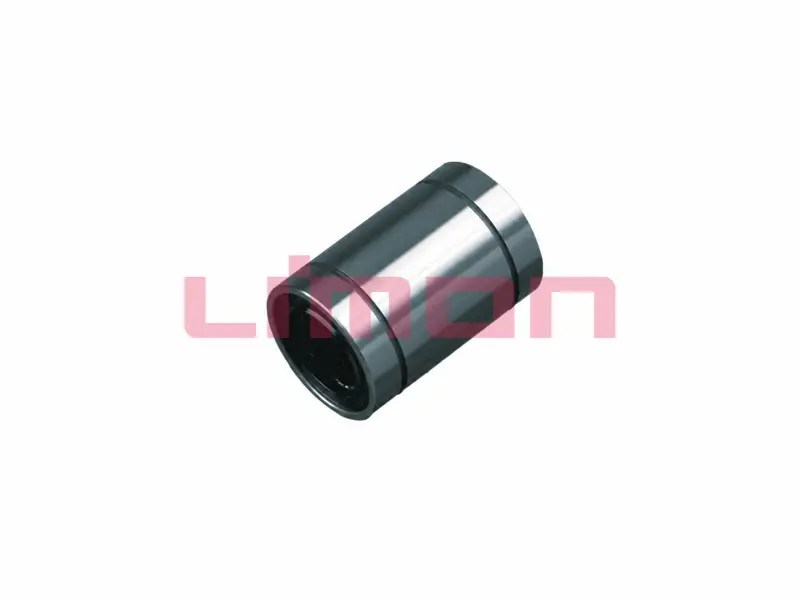
Load direction and housing stiffness affect the result
The rolling-element arrangement and the opening can make the relationship between applied load and catalog rating important. Use the relevant directional or correction data where specified. Do not treat a catalog’s principal-direction rating as an unrestricted machine payload.
The housing must retain the bearing without unwanted deformation. For an open housing, check how its fasteners and adjustment features load the sleeve. Smooth movement before installation does not prove the same condition after the housing has been tightened to the machine.
For two parallel shafts, verify their alignment and the table’s stiffness as an assembly. Forcing a rigid table onto misaligned shafts can produce drag that is wrongly blamed on bearing quality.
Protection and maintenance still need a design
Choose the specified seals, wipers, lubrication and external protection for the environment. The word “closed” describes the sleeve and does not mean the bearing is contamination-proof. The word “open” does not tell you which seal package was ordered.
Check access to lubrication points with the carriage at its service position. Where chips or liquid can reach the shaft, review covers or shielding without obstructing the bearing’s travel or support clearance. Keep the selected lubricant and maintenance method with the machine documentation.
Order the bearing and its interfaces as one package
For LIMON linear bushings, send shaft diameter and tolerance, support-section drawing, housing type, opening orientation, load direction and travel. Identify whether you need the standard, open, adjustable or long variant rather than requesting only “LM bearing.”
The LM Series page lists relevant model variants. Contact LIMON with the complete code and assembly drawing so the bearing, shaft support and housing can be checked together before repeat purchasing.