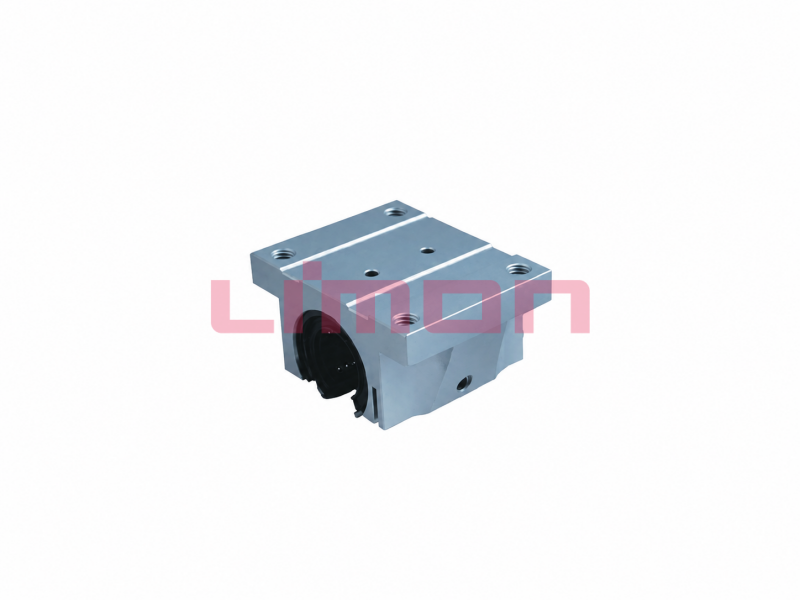
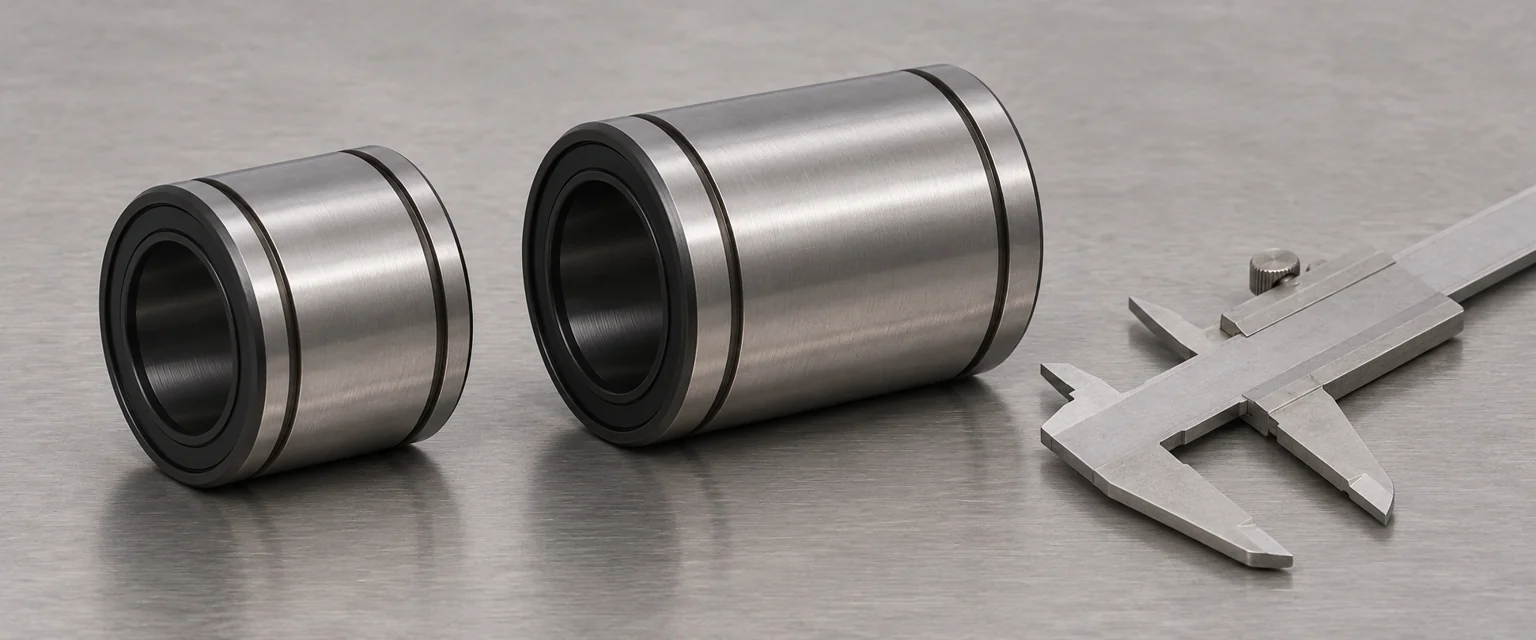
LM and LME linear bearings can share a nominal shaft diameter while having different outside dimensions and fit requirements. They are separate dimensional families, so a matching bore number is not enough for a direct replacement. Check outside diameter, overall length, retention features and the applicable shaft and housing tolerances.
For a concrete example, LIMON’s published tables list LM16UU with a 16 mm nominal bore and 28 mm outside diameter, while LME16UU has a 16 mm nominal bore and 26 mm outside diameter. The same shaft size therefore does not establish the same housing fit.
Both families are metric
The distinction is not “metric versus imperial.” Both LM and LME families include metric shaft sizes. LME is commonly associated with a European dimensional family, but the manufacturer’s model drawing is the authority for the item being purchased.
THK’s bushing range separately identifies LM and LME products and describes the European standard-size construction. That naming context helps identification; it does not prove cross-brand interchangeability.
Do not confuse LME with a flange designation. A flange changes the mounting interface and is identified by the relevant full series code. Closed, open, adjustable and long variants also need their own drawings.
Compare published dimensions, not appearance
The following nominal bore and outside-diameter examples come from LIMON’s LM Series table and LME Series table, checked for this article. They are not a complete replacement chart. Confirm length, tolerances and all suffix details on the current dimensional drawing before ordering.
| Nominal shaft size | LM model | LM outside diameter, mm | LME model | LME outside diameter, mm |
|---|---|---|---|---|
| 16 mm | LM16UU | 28 | LME16UU | 26 |
| 20 mm | LM20UU | 32 | LME20UU | 32 |
| 30 mm | LM30UU | 45 | LME30UU | 47 |
| 40 mm | LM40UU | 60 | LME40UU | 62 |
The 20 mm row is particularly useful: matching bore and outside diameter still do not prove that length, retaining-ring positions or running fit are identical. The direction of the dimensional difference is not a simple “LME is always larger” rule either.
For replacement work, identify what the housing actually locates. A shoulder may locate one sleeve end, retaining rings may locate grooves, or a flange may establish the mounting plane. Each arrangement makes different dimensions critical.
A measurement sheet for an unidentified bearing
| Item to record | Why it matters |
|---|---|
| Full marking and suffix | Distinguishes family, seals and construction |
| Nominal shaft size and measured shaft condition | Identifies the intended running interface |
| Outside diameter and housing-bore specification | Establishes the external fit |
| Overall sleeve length | Checks axial envelope and shoulder location |
| Retaining-groove positions and widths | Checks whether existing retention still works |
| Flange geometry, if present | Defines bolt pattern and seating interface |
| Open or adjustable construction | Checks support clearance and housing design |
| Lubrication and sealing details | Preserves the intended maintenance arrangement |
Use calibrated measuring equipment appropriate to the required fit. A nominal measurement from a worn shaft or distorted old sleeve should not be treated as the original design tolerance. Keep the supplier’s dimensional drawing alongside your measurements.
Fit affects movement even when the housing matches
The bearing’s internal dimensional convention, shaft tolerance, shaft condition and housing can affect assembled clearance and drag. Request the applicable limits rather than assuming one shaft-fit recommendation covers all LM and LME products.
Avoid a universal claim that one family is always tighter, more accurate or longer-lasting. Those outcomes depend on the actual bearing specification and installation. For open or adjustable variants, the housing and orientation add further conditions; the open-versus-closed bushing guide explains that separate selection task.
If a replacement feels tight after housing installation, inspect shaft alignment, housing condition and the approved fit before changing adjustment or forcing movement. A part that is correct as an individual component can still be installed into an incompatible assembly.
Can LM20UU replace LME20UU if both outside diameters are 32 mm?
Not on that information alone. The shared outside diameter in the published examples closes only one comparison field. Length, retention geometry, tolerances and the assembly’s required performance must also match or be deliberately redesigned.
What should a distributor keep in a repeat-order specification?
Keep the full approved model code, manufacturer, drawing revision, dimensions, suffixes and shaft/housing requirements. Record whether alternate suppliers are permitted and what acceptance checks apply. Reordering by “20 mm linear bearing” leaves too many interfaces undefined.
For a LIMON linear bearing enquiry, send the old code or clear photographs, the measurement sheet, quantity and application. Identify whether the order must fit an existing housing or whether the linear bushing assembly can be specified as a new design.