A stepper motor rated at 2 N·m holding torque can still miss steps on a fast move. Holding torque is measured with the motor energized at rest. For sizing an axis, plot the torque the move requires against the motor and driver curve at the shaft speeds the machine will actually use.
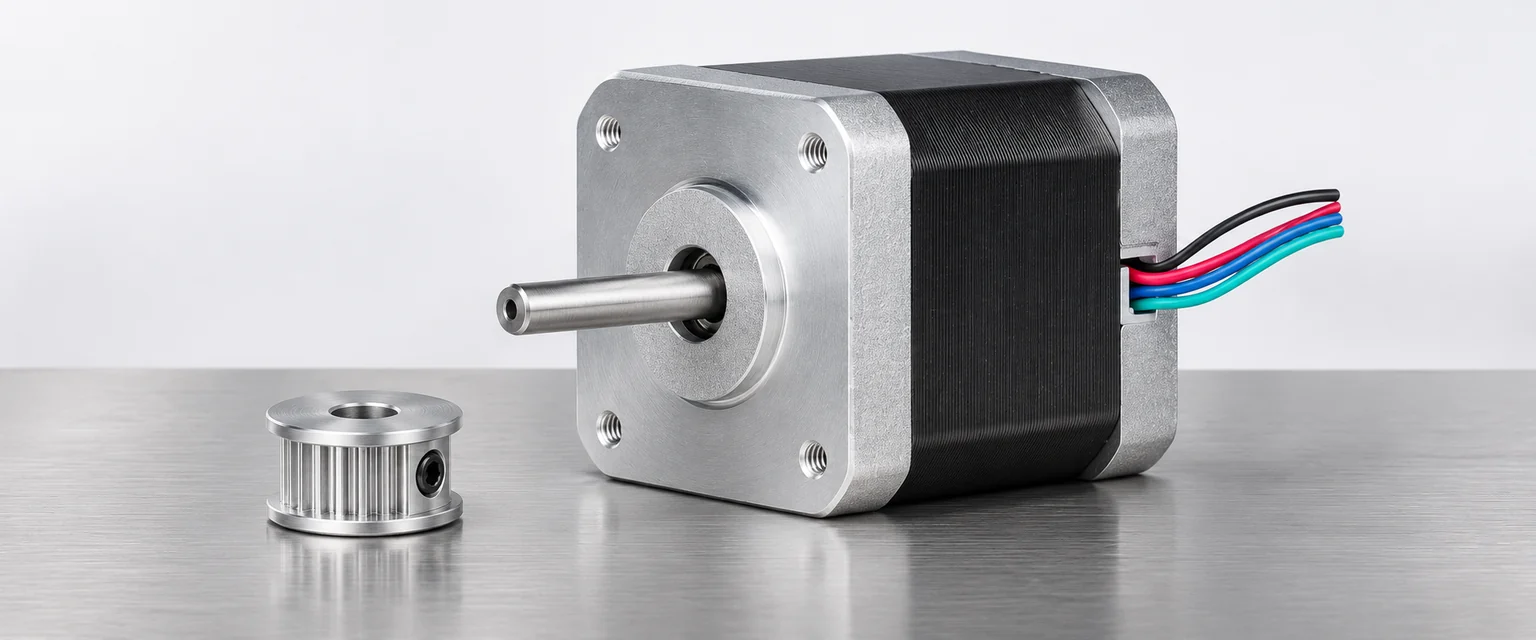
Find the curve for the motor and drive combination
Start with the motor part number and the curve's supply voltage, driver and phase current. Check any wiring and step settings stated with the curve. The values should describe the combination you will install. If the horizontal axis is in pulses per second, establish how many command pulses represent one shaft revolution for those conditions before converting it to rpm.
The pull-out curve describes the load an already running motor can carry in synchronism at each speed under the test conditions. Starting directly at a given speed is a different check. Oriental Motor's curve guide distinguishes pull-out torque from the pull-in limit, where available, and explains why attached inertia affects starting. Use the planned acceleration ramp when comparing the move with the curve.
Put the acceleration and cruise points on the plot
Consider a hypothetical horizontal belt axis with a direct-drive pulley pitch radius of 0.020 m. A 0.60 m/s carriage speed means 30 rad/s at the motor, about 286 rpm. Accelerating from rest to that speed in 0.15 s with a constant ramp requires 200 rad/s². If total inertia referred to the motor shaft is 0.0030 kg·m², the acceleration term is 0.60 N·m. That inertia includes the rotor and the reflected moving load as well as the pulley. For this example, assume a separate 0.15 N·m resisting torque referred to the shaft.
| Part of move | What to compare with the curve |
|---|---|
| Speed ramp | Approximately 0.75 N·m during the ramp, checked across the speeds it traverses |
| Steady move near 286 rpm | 0.15 N·m with the same resistance assumption |
| Deceleration and reversal | Signed torque from the actual ramp and process forces |
Check near the end of acceleration as well as at full cruise. In this example the speed can be nearly the same, yet the accelerating point requires five times the torque. For a screw axis, calculate speed from its actual lead and include screw inertia. For gearing, refer speed, load torque and inertia to the motor shaft consistently. Oriental Motor's sizing calculations give the standard input relationships.
Confirm the margin on the machine
Use the manufacturer's recommended margin when available. A curve measured under different electrical conditions or at a different current is a poor basis for moving that margin closer to zero. Check temperature, the worst payload and the most demanding start, stop or reversing move. A motor that runs a single unloaded cycle may behave differently after the machine warms or at a speed where the assembled mechanism vibrates.
For an open-loop axis, verify travel against an independent reference through repeated operating cycles. Compare the commanded position with the actual position after the same return move. A controller pulse counter can show the requested moves even when the motor loses synchronism. If errors occur in only one part of the ramp, log the speed and load there before changing current or selecting a larger frame.
When asking about a LIMON SM series stepper motor, include the supply and driver, transmission geometry, moving mass, speed profile and duty cycle in the demande de renseignements sur une candidature. Request the applicable speed-torque curve for the proposed combination. The motion product catalogs help identify the motor and drive family first.