Choosing the wrong ball screw can cause overload, sudden failure, machine downtime, and serious safety risks. Misjudging load capacity leads to premature wear, lost accuracy, and costly repairs. Understanding force limits is the solution to safe, reliable ball screw design.
A ball screw’s load capacity depends on its diameter, lead, material strength, mounting method, and operating conditions. Knowing how force limits are defined helps engineers select ball screws that safely handle real-world loads.
To clearly understand how much force a ball screw can hold, it is essential to examine overload failure modes, structural limits, and practical engineering considerations.

There Are Five Ways a Ball Screw May Fail Due to Overload
When evaluating how much force a ball screw can hold, it is important to understand that failure rarely occurs in a single, obvious way. Overload conditions can trigger multiple mechanical failure mechanisms, each affecting accuracy, lifespan, and safety.
One common failure mode is excessive contact stress between the balls and the raceways. When axial loads exceed the rated static or dynamic capacity, contact pressure rises sharply. This leads to permanent indentation, surface fatigue, and accelerated wear. Once raceways are damaged, vibration increases and positioning accuracy rapidly deteriorates.
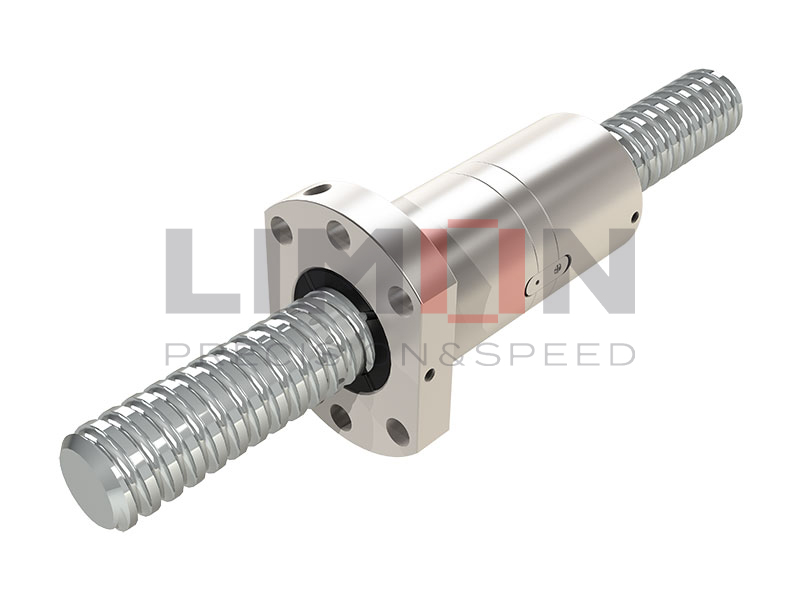
Another overload mechanism is damage to the ball circulation system. Excessive force can deform return tubes or internal circulation paths, preventing smooth ball movement. This causes uneven load distribution, increased friction, and in severe cases, jamming of the ball nut.
Nut body deformation or cracking is another critical failure mode. The nut is designed to withstand a defined axial force. Exceeding this limit introduces internal stress concentrations that can cause cracking over time. In vertical applications, this type of failure can lead to sudden load drops and serious safety hazards.
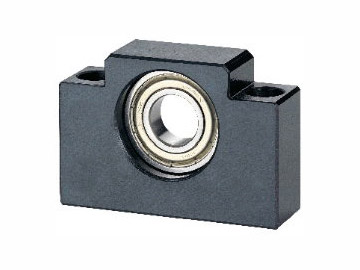
Support bearing overload is also frequently overlooked. Even if the ball screw shaft is adequately sized, undersized or improperly mounted support bearings can fail under axial load, leading to misalignment and secondary damage.
Finally, compressive overload can cause shaft instability, resulting in buckling. This failure mode often determines the maximum usable force for long or slender ball screws.
Buckling
Buckling is one of the most critical factors limiting how much force a ball screw can hold, especially in applications involving compressive axial loads. Unlike material fracture, buckling is a structural instability that can occur even when stresses remain below material yield limits.
Buckling happens when compressive force exceeds the critical buckling load of the screw shaft. At that point, the shaft deflects laterally rather than continuing to carry additional load. Once buckling begins, the load-carrying capability collapses rapidly, often causing permanent bending or complete failure.
The critical buckling load depends on several parameters: screw diameter, root diameter, unsupported length, end support conditions, and material stiffness. Among these, unsupported length has the greatest influence. A longer unsupported length dramatically reduces buckling resistance, making long-travel applications particularly sensitive to this failure mode.
Support configuration is equally important. Fixed–fixed mounting provides the highest resistance to buckling, while cantilevered or simply supported configurations offer much lower capacity. Real-world installations must be evaluated carefully, as idealized mounting assumptions often overestimate allowable force.
Because buckling can occur suddenly and without visible warning, it is one of the most dangerous overload modes. Accurate buckling calculations are therefore essential when determining the maximum compressive force a ball screw can safely withstand.
Fracture Load
Fracture load defines the absolute upper limit of how much force a ball screw can hold before material failure occurs. This type of failure is associated with the tensile strength of the screw shaft and the structural integrity of the nut and threads.
Fracture typically occurs under extreme axial tension, shock loads, or impact conditions rather than steady-state loading. Applications involving rapid acceleration, emergency stops, or sudden load changes can generate forces that exceed the material’s ultimate strength.
Several factors influence fracture load, including the screw’s root diameter, material grade, heat treatment, surface condition, and thread geometry. Manufacturing defects, corrosion, or surface damage can significantly reduce fracture resistance.
Although ball screws are usually designed with a large safety margin between rated load and fracture load, improper application can erode this margin. Repeated overload cycles can initiate microcracks that grow over time, eventually leading to sudden and catastrophic failure.
To reduce fracture risk, designers should minimize shock loading, use conservative safety factors, and ensure the ball screw is properly sized for worst-case loading scenarios, not just nominal operating conditions.
Technical Tip
When determining how much force a ball screw can hold, it is critical to distinguish between catalog ratings and real-world performance. Manufacturer ratings assume ideal conditions, while actual applications introduce misalignment, vibration, temperature changes, and dynamic loads.
Always apply appropriate safety factors. Static applications typically require a safety factor of at least two, while dynamic or shock-loaded systems often need higher margins. This ensures reliable operation well below critical limits.
Side loads should be avoided whenever possible. Ball screws are designed for axial loads, and even small lateral forces can significantly reduce load capacity and service life. Proper linear guides must be used to support side loads.
Lubrication also affects load capacity. Poor lubrication increases friction and heat, accelerating wear and reducing effective force capability. Regular maintenance preserves smooth ball circulation and consistent load distribution.
Finally, system stiffness matters. Flexible machine structures can amplify forces through vibration or resonance, increasing the effective load on the ball screw. A rigid, well-aligned system allows the ball screw to safely operate closer to its theoretical limits.
Conclusion
A ball screw’s force capacity depends on buckling limits, fracture strength, overload modes, and system design; understanding these factors ensures safe, reliable, and long-lasting performance.Pour toute question complémentaire, veuillez contacter [email protected]