
The DN limit and shaft critical speed address different restrictions. DN relates screw speed to the nut’s rolling-element circulation system using a manufacturer-defined diameter. Critical speed concerns the rotating shaft’s tendency to resonate. The permissible operating speed must satisfy both, along with the limits of the bearings, drive and complete axis.
A short, thick shaft may pass its critical-speed check while the nut circulation system governs. A long shaft can be limited by resonance even when its DN value appears modest. Checking only one of these mechanisms leaves an incomplete selection.
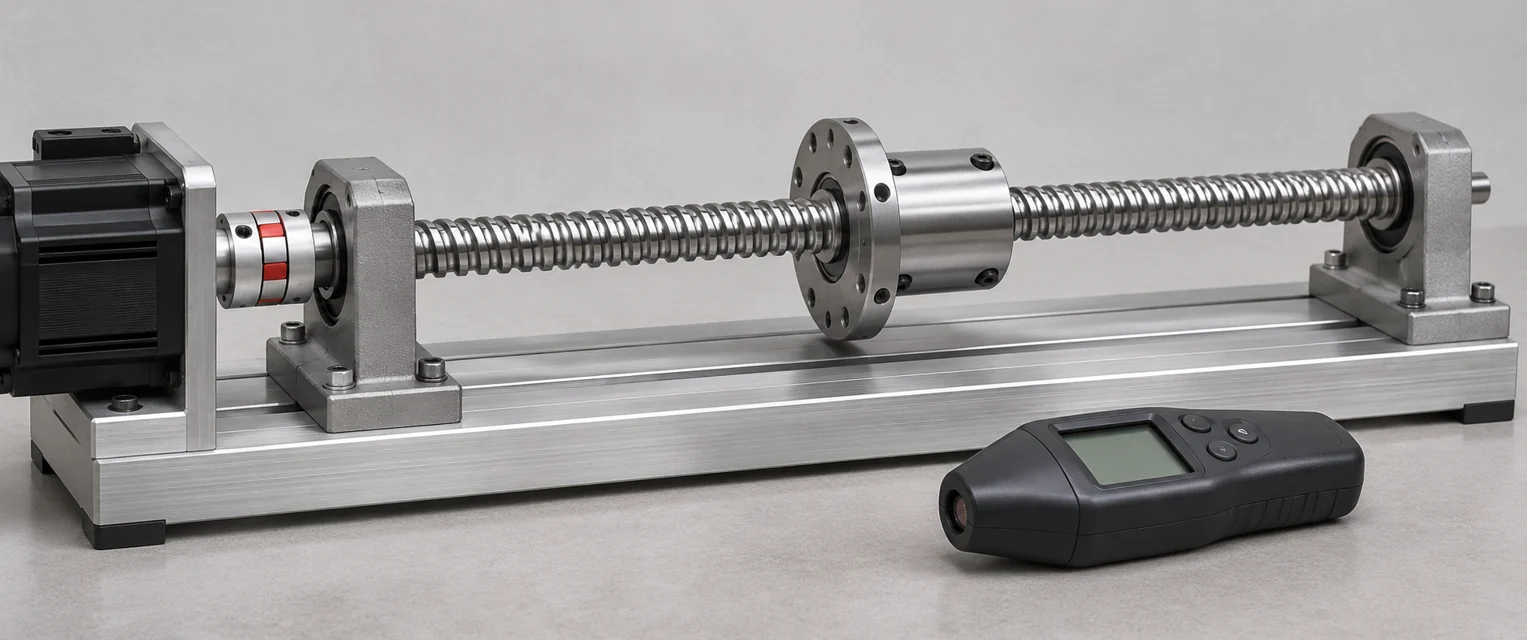
DN does not always use nominal shaft diameter
DN is a diameter-speed product, but the definition of D must come from the applicable catalog. Some manufacturers use nominal shaft diameter; others specify a ball-center diameter for their calculation.
THK’s permissible-speed guidance uses the ball center-to-center diameter in its stated DN equations. NSK’s automation brochure defines its d·n check using shaft diameter. These conventions should not be mixed.
Write both the numerical DN limit and the diameter definition in the selection sheet. A limit copied without its diameter convention or applicable nut family is not a usable engineering input.
Shaft critical speed depends on support and span
The shaft check depends on shaft geometry, unsupported length and boundary conditions. Increasing the relevant length can reduce the calculated critical speed substantially. Changing the bearing restraint changes the calculation as well.
Use the selected manufacturer’s equation or chart, including its stated reduction or margin. Determine whether that margin is already included before applying an additional multiplier. Do not quietly compare a theoretical resonance speed from one source with a reduced permissible speed from another.
Steinmeyer’s speed-limit discussion also illustrates why the diameter-speed product alone is insufficient to establish maximum rpm. A catalog’s general maximum-speed guidance remains relevant even when a calculated DN number passes.
Convert the machine’s linear speed into screw rpm
For a rotating screw driving a nonrotating nut:
n = 60v / p
where n is screw speed in rpm, v is linear speed in mm/s, and p is lead in mm/revolution. Lead is travel per revolution, which is not necessarily the spacing between adjacent grooves on a multi-start screw.
A hypothetical axis requiring 250 mm/s with a 10 mm lead requires 1,500 rpm. Reducing the lead to 5 mm doubles the required screw speed to 3,000 rpm for the same linear motion. This kinematic calculation does not establish whether either assembly is suitable.
Include rapid traverse and all intended operating modes. If a transmission sits between the motor and screw, calculate screw rpm separately from motor rpm.
A limiting-speed worksheet
The following assumed values show how to identify the governing restriction. They are not ratings for any LIMON product.
| Vérifier | Assumed input | Result |
|---|---|---|
| Machine speed | 250 mm/s; 10 mm/rev lead | Required screw speed 1,500 rpm |
| Nut circulation limit | DN = 70,000; applicable D = 24 mm | 2,917 rpm, approximately |
| Shaft permissible speed | Supplier calculation for the actual span and supports | 2,200 rpm |
| Bearing permissible speed | Applicable bearing specification | 4,000 rpm |
| Other assembly maximum | Applicable supplier limit | 3,000 rpm |
Among these assumed speed limits, 2,200 rpm governs. The corresponding kinematic linear speed is 2,200 × 10 / 60, or about 367 mm/s. The required 250 mm/s is below that value, but load, life, temperature and control checks remain separate.
If the same hypothetical DN limit uses D = 30 mm instead, the circulation result becomes about 2,333 rpm. This is why substituting nominal diameter without checking its definition can change a selection decision.
Problems a speed-limit check does not solve
Passing the rpm limits does not prove that the motor can accelerate the screw and load, that lubrication is adequate, or that the nut will remain within its thermal limits. It also does not resolve shaft buckling under compressive load or demonstrate the required positioning accuracy.
Avoid deliberately running a machine up to a suspected resonance to determine its limit. A selection review should establish permissible conditions before commissioning. Unexpected vibration should trigger a controlled investigation of support, alignment, coupling and operating speed.
What to request from a ball screw supplier
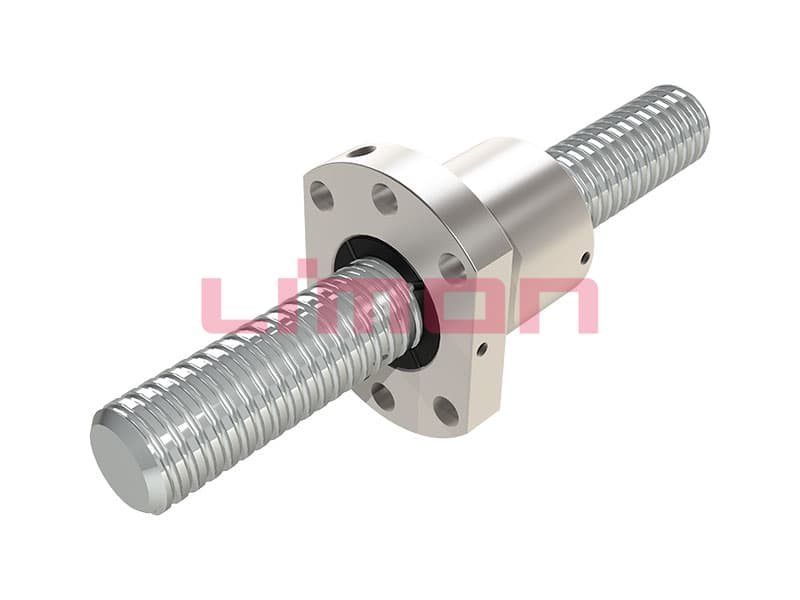
Pour un LIMON ball screw assembly, provide shaft length, bearing span, support arrangement, nut code, lead, orientation and the complete speed profile. Ask for the applicable DN convention, nut-speed limit and shaft-speed assessment. Include the proposed support units, rather than identifying only the shaft diameter.
Le SFNU product page helps identify the family, while LIMON’s enquiry team can review the exact model and application inputs. Keep the confirmed calculation with the drawing revision so a later length change triggers a new review.
_1.jpg)