A steel ball screw can change length enough during warm-up to consume a positioning tolerance on its own. As a first estimate, multiply the effective screw length by the rise in shaft temperature and the shaft material's expansion coefficient. Then check where the screw is axially restrained and where the machine measures position. Those two details decide how much of the estimated growth appears at the work point.
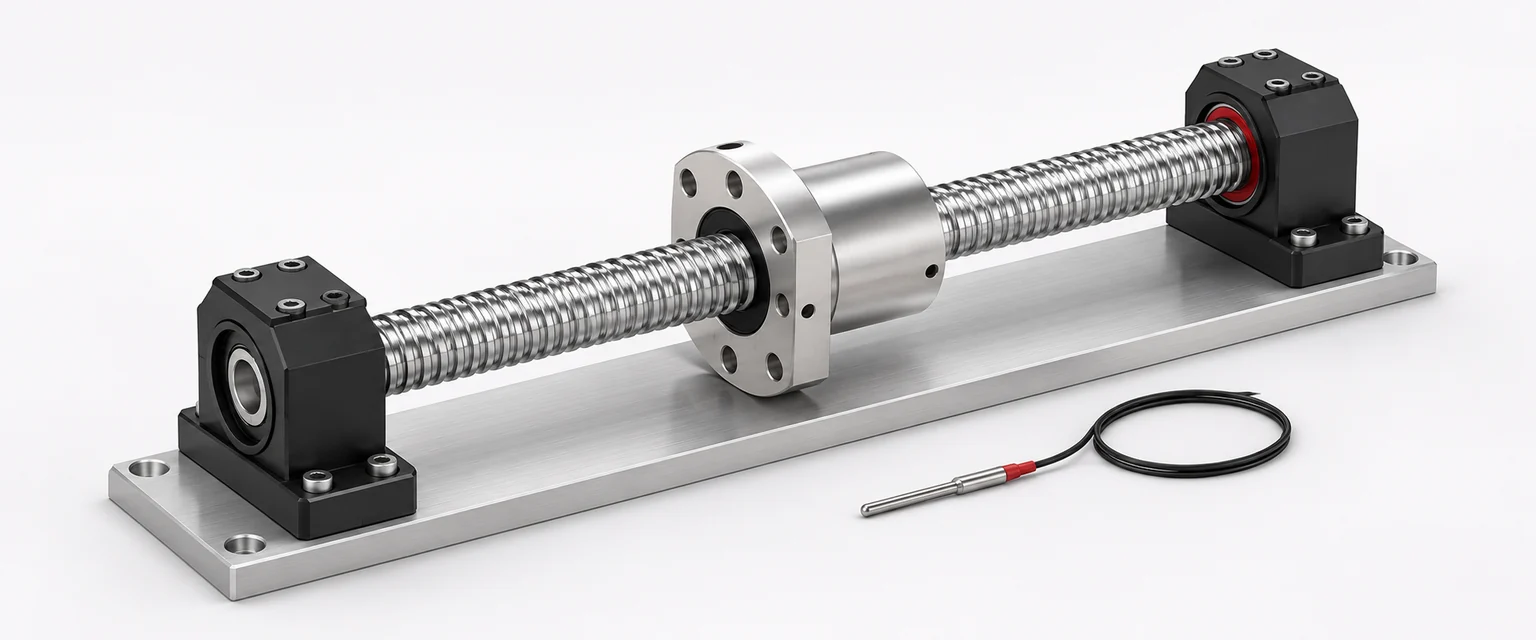
Calculate the growth over the length that matters
For free expansion at a uniform temperature, ΔL = α × L × ΔT. Use the coefficient for the actual shaft material. In its ball screw positioning guide, THK uses 12 µm per metre per °C for the steel screw example. A 0.80 m effective length warmed by 8 °C would therefore grow about 76.8 µm. This is an illustrative free-expansion estimate.
In a simplified fixed-supported assembly with one axial locating end, consider a nut at 0.20 m and again at 0.70 m from that end. With the same uniform temperature rise, growth from the locating end to those positions is about 19.2 µm and 67.2 µm. The change between the two stations is 48 µm over 500 mm. If you zero the machine at the first station after warm-up, that removes a constant offset there. The change across the travel remains.
Use the locating point shown in the assembly drawing. The distance from a carriage limit, the nominal travel and the overall screw length can all be different. In a design with two axially restrained ends, the free-expansion number is a useful scale for the problem. Actual displacement and changes in internal force depend on the end supports, any pretension and the stiffness of the surrounding structure. See the fixed-supported and fixed-fixed comparison for the distinction between support layouts.
Look for position drift as well as heat
If the screw is warmer near the nut or support at one end, a single temperature reading can misstate the growth along the travel. For a first segmented estimate, divide the relevant screw length into zones and add α × zone length × zone temperature rise for each. Housing temperature is useful for tracking a warm-up trend. It is a proxy for shaft temperature and should be recorded as such.
Record cold positions against a stable external reference, run the duty cycle that the machine will actually use, then repeat the same readings as it warms. Include a station near the axial datum and one near the far working position. Keep the load, approach direction and dwell consistent. A growing difference between stations points to a position-dependent error. A similar shift at every station is a reason to look at the reference and its mounting as well as the screw.
| Record | Why it belongs in the log |
|---|---|
| Elapsed time and recent cycle | Shows whether the error stabilizes or returns after idle periods |
| Temperature, sensor location and cold baseline | Separates a shaft measurement from a bearing housing or ambient reading |
| Command and external position at each station | Shows the size and shape of the drift across travel |
| Support arrangement and measuring reference | Explains which structural changes can move the datum |
Decide how the machine will manage the drift
A repeatable warm-up may be enough where production starts after the same startup cycle each day. When speed, idle time or load varies widely, check the error through those transitions before depending on a fixed compensation value. A measured temperature correction needs verification across the actual travel and duty cycle.
For an axis using only a motor encoder, the controller observes rotation and infers displacement from screw lead. A properly installed linear scale can measure carriage travel directly. It still leaves errors between the scale's measuring line and the work point, such as changes in straightness or angular alignment. When sizing the screw itself, the same THK guide discusses ways to reduce heating, including correct lubrication and checking whether a different lead can reduce rotational speed for the required travel rate.
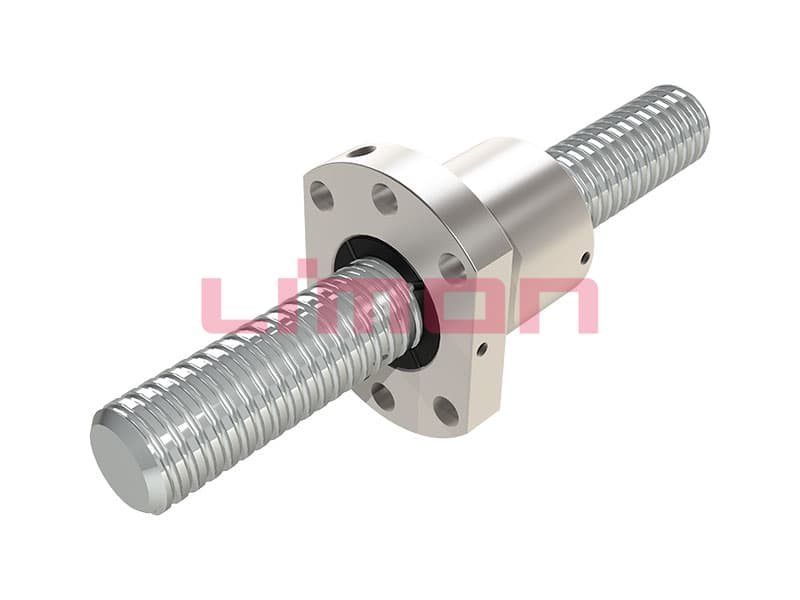
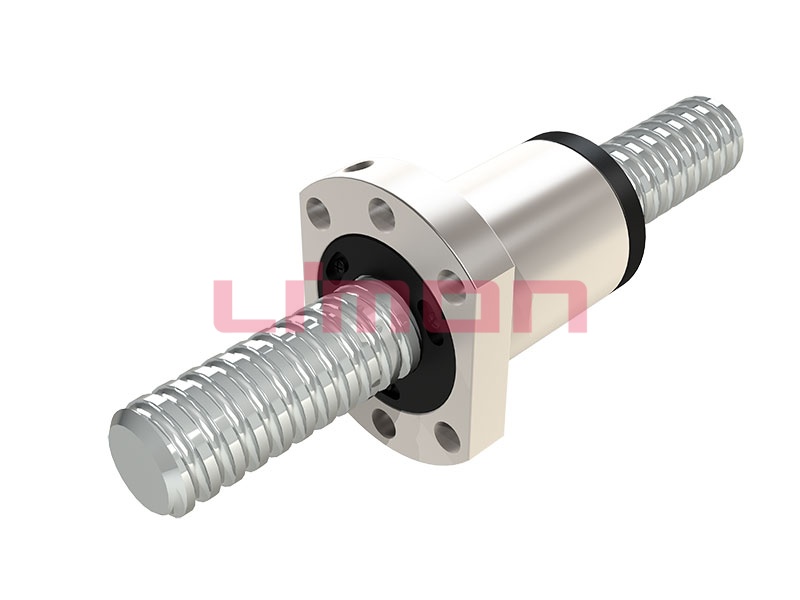
Para un ball screw selection enquiry, include the screw drawing, support arrangement, cold and warm position readings, sensor locations and required tolerance. The LIMON ball screw range y SFNU dimension page help identify the configuration when the machine record lists only a nominal diameter and lead.