In common ball-screw naming, 1605 identifies a nominal 16 mm screw with 5 mm travel per revolution, while 1610 identifies a 16 mm screw with 10 mm travel per revolution. Confirm the supplier’s full code. At the same screw rpm, a 10 mm lead moves twice as fast; at the same axial force, it needs approximately twice the steady driving torque if efficiency is equal.
That does not make one lead universally better. A 5 mm lead gives more mechanical advantage, while a 10 mm lead reduces the rpm needed for a target linear speed. Motor torque at the actual operating speed, shaft limits and the axis duty cycle decide which tradeoff is useful.
Confirm what the code specifies
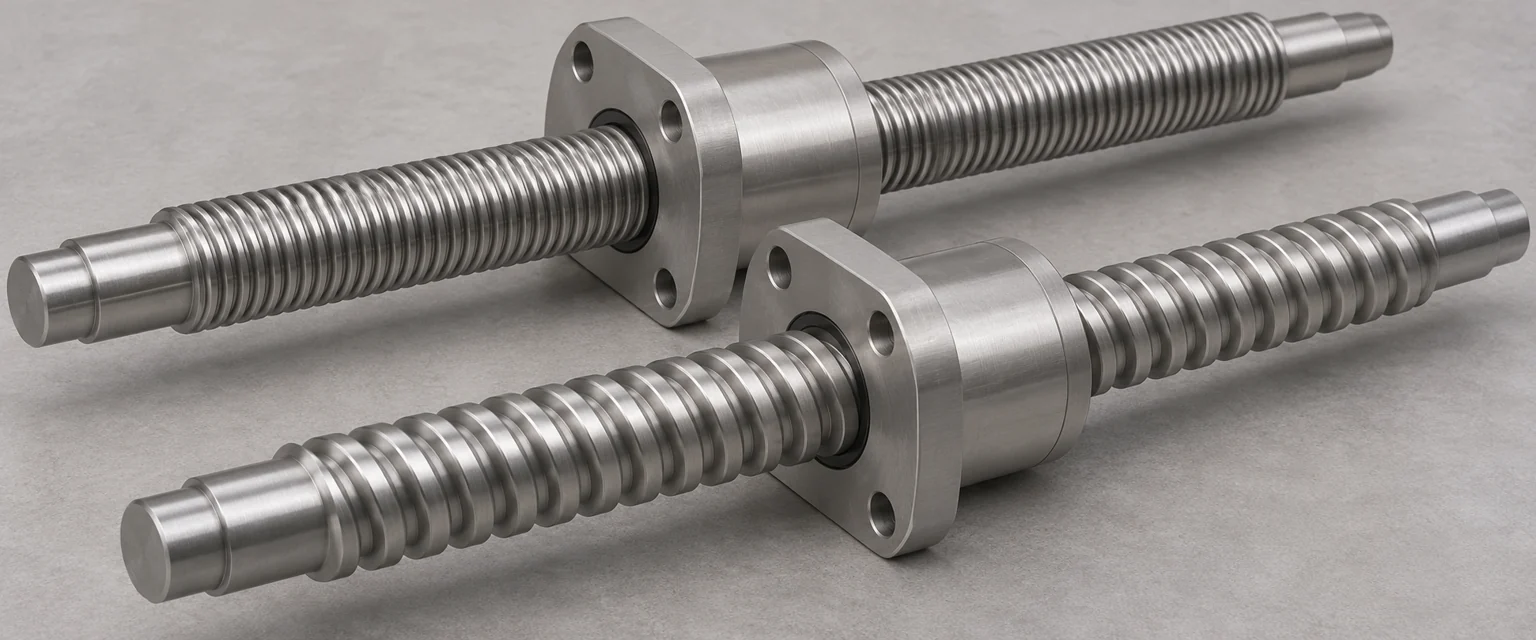
Treat the abbreviated number as an identification aid, not a complete order specification. Thomson’s KGS-1605 product record, for example, explicitly lists 16 mm nominal diameter and 5 mm travel per revolution. A complete enquiry must also define nut family, thread direction, accuracy, clearance or preload, shaft length and end machining.
Lead and thread pitch are different quantities on a multi-start screw. Counted groove spacing alone is not sufficient to identify travel per revolution. Use the drawing or a controlled measurement of the assembled unit.
Compare the required rpm at your target speed
The relationship is n = 60v / p, where v is in mm/s and p is in mm/revolution.
| Kinematic comparison | 1605, assuming 5 mm lead | 1610, assuming 10 mm lead |
|---|---|---|
| Travel per screw revolution | 5 mm | 10 mm |
| Speed at 1,500 rpm | 125 mm/s | 250 mm/s |
| Screw rpm for 200 mm/s | 2,400 rpm | 1,200 rpm |
| Revolutions for a 300 mm move | 60 | 30 |
These are calculated motion values, not rated speeds. Both DN limits and shaft critical speed still need checking for the actual nut, shaft length and support arrangement.
For a stepper-driven axis, lower rpm can be valuable because the available torque must be read at the operating speed, not from the holding-torque label. For a servo axis, check the motor’s torque-speed envelope and the complete acceleration profile as well.
Compare driving torque with explicit assumptions
For steady axial force in a simplified screw drive:
T = Fp / (2πη)
T is driving torque in N·m, F is axial force in N, p is lead in metres per revolution, and η is assumed driving efficiency. This calculation excludes acceleration torque and additional component losses. Thomson’s ball-screw torque calculator provides a supplier calculation resource; check the definitions of every input before comparing results.
For an illustrative 800 N force and an assumed efficiency of 0.90, the 5 mm lead requires about 0.71 N·m. The 10 mm lead requires about 1.41 N·m. These values are not a motor recommendation or a LIMON efficiency specification.
At a target linear speed of 200 mm/s, however, the two cases require 2,400 and 1,200 rpm respectively. Compare available motor torque at those two different speeds. Equal torque at equal rpm is not the same comparison as equal force at equal linear speed.
Command resolution is not positioning accuracy
With direct drive and an assumed 3,200 commanded increments per revolution, nominal travel per increment is 5 / 3,200 = 0.0015625 mm for the 5 mm lead and 0.003125 mm for the 10 mm lead.
Those are command increments. They do not establish positioning accuracy, bidirectional repeatability or minimum reliable movement. Lead error, backlash, elastic deflection, mounting, feedback and motor behavior remain in the system. Microstepping a motor into more increments does not remove these errors.
State the actual accuracy and repeatability requirement separately in the specification. Do not purchase a screw solely because its calculated distance per pulse looks smaller than the target tolerance.
Acceleration and vertical axes change the decision
At the same linear acceleration, a larger lead requires less angular acceleration of the screw but changes the load inertia reflected to the motor. The net motor demand depends on both moving-mass inertia and rotating inertia. Work through the complete motion profile rather than selecting from steady torque alone.
For vertical motion, consider gravity during operation and when power is removed. Neither a 1605 nor a 1610 designation establishes a safe holding function. The brake, support and control arrangement must suit the application; do not assume a ball screw is self-locking.
Also check nut travel, available end space, lubrication and the motor-mount arrangement. A lead change can require a different nut envelope even when nominal shaft diameter stays at 16 mm.
A useful choice rule
Start with a 5 mm lead candidate when force advantage and lower command increment are useful, then verify the required screw rpm and the actual motor curve. Evaluate a 10 mm lead when reducing operating rpm helps the speed requirement, then verify the higher torque demand per unit axial force and the full acceleration calculation.
Para un LIMON ball screw enquiry, send the desired linear speed, force, stroke, orientation, cycle profile and motor information. Identify the proposed SFNU nut y support arrangement. Ask for model confirmation before treating a 1605-to-1610 change as a direct replacement.